

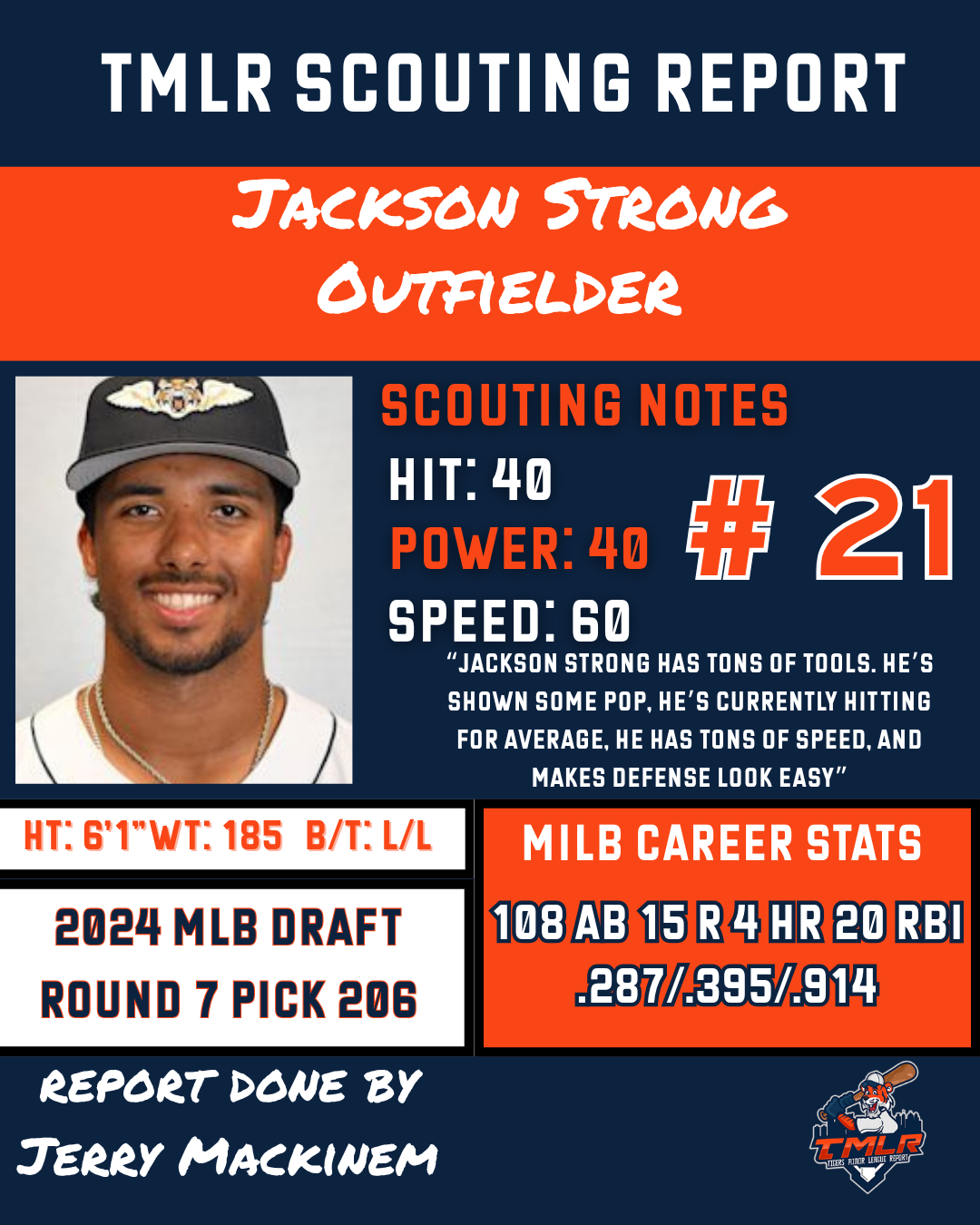
What does it take to adjust to a new level of baseball while staying true to your style of playing? Well, Tigers’ minor league outfielder Jackson Strong is getting his first taste of that since arriving with the West Michigan Whitecaps.
I sat down with Jackson to talk about routine, adapting to the ebb and flow of the game, teammates who inspire him, and how he’s embracing the challenge of a new affiliate assignment.
Emily Waldon:
The biggest thing that a lot of the guys will talk about is the number of fans here versus the lack of fans in the Florida State League. How much of an impact have you noticed that’s already had on you since you started in West Michigan?
Jackson Strong:
Yeah, it’s definitely a lot different. Even just walking up to the plate and hearing people actually clap and be cheering you on and wanting you to succeed, and it makes you want it that much more in the box a little bit too. If it’s a big spot in the game, you want to come through for the fans and you want to come through for your boys, and yeah, just overall, (the fans) are great. They cheer you on all the time. It’s awesome, nothing like I’ve ever experienced before for sure.
Waldon:
Have you ever played in an environment like this?
Strong:
No, I played in Trenton in 2024 in Summer Ball, and they sold out a few times. I played in front of seven to 8,000 fans, and that was the first time I’ve ever done that, so that was maybe two games, and I was like, “Wow.” But now, being here, hopefully will be more consistent.
Waldon:
As a player, we know everyone has their preparation process. This being your first time with the Midwest League, what was your mentality before coming here, and how did you mentally prepare for that?
Strong:
I pride myself on my preparation just because I know that if I’m prepared and I do enough in practice, then I have no other choice but to be prepared for the game. So, I’m a big proponent of that, and I love to make my practice harder than the game, and I like to challenge myself, and it just makes me more confident for the game. I know if I can master that in practice, I know I’m going to be successful in the game. I think doing that in Lakeland and really the coaching staff there really helped me get a routine down every day in terms of what I do in the cage, what I do in terms of defensive stuff, and just doing it all the same thing.
Even coming down to little things like going to a new place for an away series, walking the field, getting a feel for the fences, getting a feel for just how the park plays, what the winds are going to do, grounding myself there, and I pride myself in even little things like that. Everything matters, I think. That’s a big Detroit saying. Everything matters, and I do believe that. I think just doing the little things right every day and having my process sets me up really well for the game.
Waldon:
How meticulous would you say you are in your preparation routine?
Strong:
I would say now, it’s definitely more so than it was in college. In college, it was roll out there two hours before the game, hit a little bit in the cage, try to hit homers on the field, put on a show, and have fun. And now it’s like, “Okay, well, I can’t really do that all the time.” I still have fun, but I’m being more intentional about what I’m doing with every swing, what my body’s doing, what I’m thinking, just having more intent overall. You have to make an adjustment going into pro ball. I think that’s huge, and I think that’s what they mean by being a pro. And this is my first full year, so I’m starting to learn what being a pro means, and I think I’m doing a better job this year learning the ropes and learning from the other guys, and watching other guys that have been here too for a while.
We’ve got some guys that have been playing pro ball for a couple of years now on this team, and I talk to all of them all the time and watch them and see what they do. I think it’s definitely more intentional now than it ever has been, and I think it has to be. You keep leveling up, play higher, hopefully moving to Double-A, Triple-A, and hopefully playing the big leagues one day. You’ve got to be even more intentional as you’re going up. I think it’s only going to get more intentional from here, for sure.
Waldon:
As far as the Midwest League level of pitching, what were you told to expect and how were those expectations met once you got started?
Strong:
I think the sequencing is really good. The catchers here are a little bit older, and they know the game. They call pitches a little bit better. I found myself these past few games getting any pitch in any count, and they’re going to throw all three pitches, all four pitches for strikes. You don’t really get that so much in the Florida State League. You get a lot of guys that are pretty raw and throw pretty hard, but they can’t always land their changeup for a strike in a one-one count, and that’s the biggest thing I’ve noticed here is that there’s more strikes in general, but also more strikes with off-speed pitches. I would say in terms of the shapes and movement, it’s pretty similar. The stuff is similar, but I think more strikes for sure. I would say that’s definitely the biggest difference.
Waldon:
After getting a taste of that pitch sequencing, as a hitter, what do you do to adjust to that?
Strong:
I think it goes back to the approach. Our hitting coach here, and our hitting coach in Lakeland, they preach approach every day, like in the hitter’s meeting and everything. I pride myself on sticking to it because you can’t get caught in between. As our West Michigan hitting coach likes to say, “You can’t get caught in between.” You can’t be looking for the fastball, slider, curveball, and the changeup. You can’t be looking for all four, so it’s more of just getting your pitch and not missing it, because they’re going to dot that change and blow it away, and they can have that. It’s about getting that fastball in that you’re looking for and not missing it, and I think that’s the biggest thing. Moving up, too, is getting your pitch that you’re looking for and not missing it.
Waldon:
I know across the organization right now, every level you look at, there is camaraderie, there’s positivity, there’s a strong and healthy culture. Coming up here, now that you’re getting to know the West Michigan coaching staff, would you say you’re already starting to see that same culture up here, too?
Strong:
Yeah, a hundred percent. It’s easy to be like that when you win all the time. We’re the Tigers, the best organization out there.
As an organization, we win a lot, so it’s a good vibe in there. It’s the same thing in Lakeland. It’s good vibes. Even in the dog days now, it’s like we’re getting to it, and vibes are still high, still pretty good in terms of team morale, and the guys love to go out there and compete. Especially when the games are close and it’s a big spot, guys find a way to come through, it’s great. I love that. That’s the best part of the game. Like, Patrick Lee making that play the other night.
Just how fired up I got, and I saw him make the play, and I’m watching out there, I got chills a little bit. Hearing the crowd, seeing the lights, it’s awesome. And like I said, winning helps, but, just a good group of guys here. Same thing in Lakeland, just good people, good coaches, good teammates, and just having a lot of fun this year.
Waldon:
I know you have a lot of respect for all your teammates, but has there been anybody who you’ve really felt, as a hitter, where you’re like, “He gets me, and I want to pick his brain a little bit more.” Anyone who stands out to you in that regard?
Strong:
Yeah, some rehab guys came down to Lakeland. Bligh Madris is one of them. I picked his brain a lot when I was in Lakeland. He and I would talk. We talked for an hour one day. I went 0 for 4 one time, and he texted me that night like, “Hey, we’re going to go in, we’re going to hit early.” And I was like, “All right, dude. Perfect.” We went in, hit and talked for an hour, and I had four hits that day. It’s stuff like that. It goes a long way, and it means a lot for a guy. He doesn’t have to do that, and it means a lot for a guy like him to want to do that for a guy like me, so it’s cool.
And here, I played with Patrick Lee in Lakeland when he was down there to start the year. He and I are really good friends, and I lean on him a lot. We talk all the time in terms of approach. Obviously, he’s right-handed, I’m left-handed, but we share similar styles of hitting a little bit, and I love the way he plays the game and how locked in he is out there. It’s crazy to see how locked in he is out there, and then he comes back in the clubhouse and he’s just a normal dude.
It’s crazy to see, he almost has a different persona out there, and I admire that. I want to be like that, and it’s awesome to see. Super humble, super good. Will never say anything about himself. He’s the best.
Waldon:
As far as your hitting mechanics, what has changed the most from before to now, being in your pro career? Anything that you made a point to adjust to match the level of pitching you’re facing now?
Strong:
I think one thing in the offseason that I worked on was plate coverage. I wasn’t getting to the away-pitch as good as I would’ve liked to. It was a posture thing, so I was working through my posture and working through my direction. It was approach-based, but it was also being a little bit more over the plate, being a little more comfortable going the other way, and keeping my direction toward left center. I pulled the ball a lot in college. I still pull the ball a lot, but it’s just more of a focus of where my body needs to be and where I’m contacting the ball, so I think the contact point was huge too.
My trainer and I did a great job with that in the offseason. I had a great offseason, and I would say just that, and just approach. Again, we would do live at-bat days, and he was a pitcher back in the day, so we’d just go live, and he’d rip. He’d rip at me and just mix, and I think competing like that and staying competitive and seeing shapes and training, all that was great. I think just being competitive and just being more comfortable with going the other way and maintaining my posture and my swing was the main thing.
Waldon:
What had to change in your posture?
Strong:
I got a little wider in my stance, which is funny because that wasn’t an intentional change. It was more just a byproduct of what we wanted. Hit a ball a hundred miles an hour to left center, then, “Okay, what do I have to do to do that? What do I have to feel to do that?” Stuff happens in your swing when you visualize a result, and your body’s going to do it, so I think that was the main thing, too. There weren’t many mechanical things that we were like, “Okay, I’m going to do this.” It was like, “Okay, see how hard you can hit a ball to the backside, and what is your body going to do? We’re going to video it and you’re going to smash five balls the other way and we’re going to see what that looks like.” And then it’s like, “Okay, I’m doing this differently with my chest. My chest is more over the ball. I’m a little wider. Maybe I’m striding a little further.”
It’s just been about looking at video of what I’m actually doing versus what I’m feeling, “feel versus real,” as they say. Watching video and trying to emulate that over and over, once I saw what I wanted to do.
Waldon:
Defensively, I know you’ve moved around (the outfield) a little bit, trying out some different positions. How has that adaptation process been for you so far?
Strong:
In college, we had a really good center fielder my sophomore year, so I played a lot of right field. I’m pretty comfortable in right field. I haven’t played a ton of left field, but I’m playing more and more as I’m moving up. I played a little bit in Lakeland, and I love all of them.
Waldon:
You just want to be in there playing.
Strong:
Yeah, I’m just trying to be in there playing. I pride myself in being able to play all three positions, and I think they’re all different in their own way. I think our outfield coach here, Arnie Beyeler, has been huge in terms of helping me with different tricks for learning all three and being able to play them well, because he always says the best way to play as an outfielder is to hit, but you’re not going to hit all the time. So, being able to play all three positions and being versatile is huge, so I think he’s been a big part of that for me as well.
 Chris Brown
  Rogelio Castillo
  Jerry McKennan