

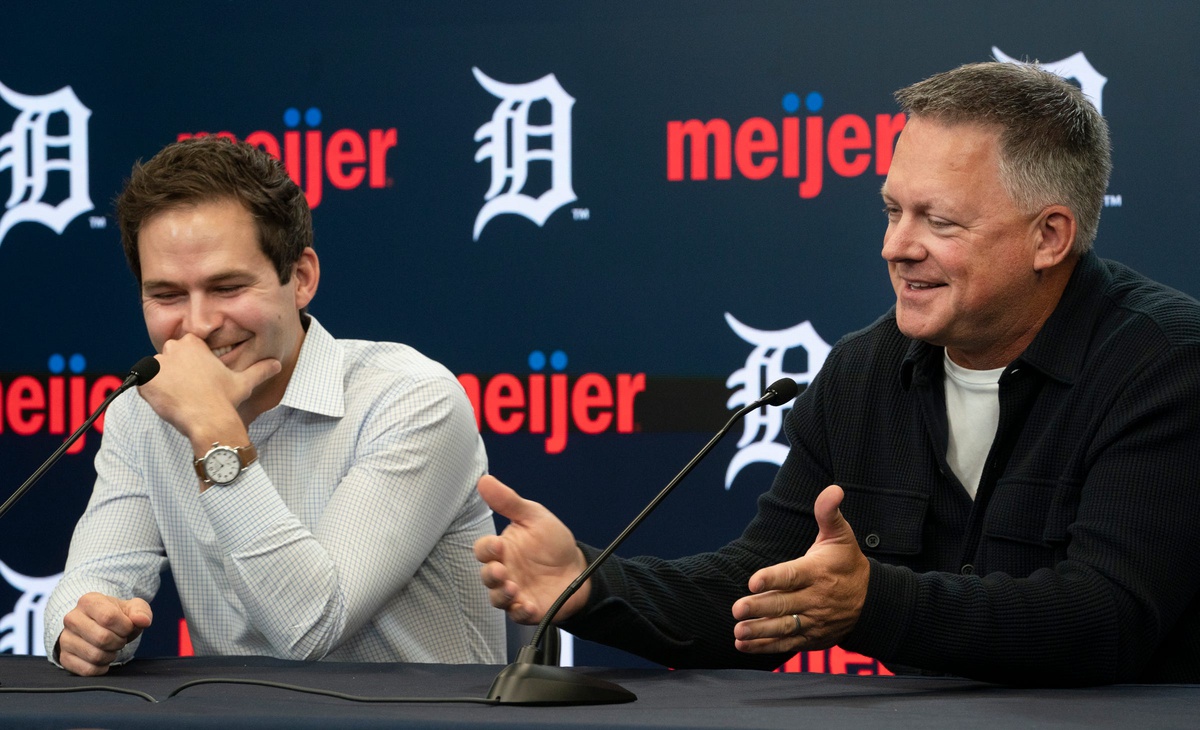
The Tigers have some major needs this offseason, and may have to get creative to address all of them.
A few weeks ago, we took a look at 10 big name free agent targets that could help take the Detroit Tigers from good to great. The majority of the players on that list will be receiving huge contracts this offseason, and the competition will be fierce for their services.
That fierce competition often leads to outrageously expensive contracts for the best free agents, as there are only a certain amount of high level free agents available every offseason, and any competitor looking to take a leap will be interested (and bidding) on their services.
Teams that sign the best available free agents are generally regarded as “winners” in the offseason, but as we all know, those big contracts can go a few different ways. Often they work out, and the player is worth every penny and more. But almost just as often, due to injury or underperformance, teams can get stuck with a massive financial obligation that isn’t worth it, which hampers their ability to add in the future due to payroll constraints.
The Tigers have generally operated like a mid-market team for the past several years. Whether that should be the case or not is up to the reader, but the fact is that Detroit’s payroll has not been top 10 in the league since 2016.
This means that compared to the highest spending teams in baseball, the Tigers need to be extra careful in who they hand out big contracts to. One big mistake by a mid-market team can be crippling for future payrolls, and we’ve seen that process play out several times before.
One strategy that is often employed by mid-market teams is to shop in the next tier below the elite free agents, where the financial obligation is less, but the impact can still be high.
Under Scott Harris and company, Detroit has generally operated under this strategy, to mixed success. And while it’s certainly possible that the Tigers go out and sign one of the best available free agents, more than likely, they’ll be shopping in the next tier down, as they have several holes to fill on the roster and only a certain amount of payroll space to work with.
If that is the case, who should they be targeting? Below are some deep dives on our best guesses:
Kazuma Okamoto
Way back in September of 1964, Masanori Murakami became the first player from Japan to play in Major League Baseball. Since then, several of his fellow countrymen have followed in his footsteps, and one needs to look no further than the 2025 World Series to see the impact that players can have when they make the leap from Japan to MLB.
This offseason, Tatsuya Imai and Munetaka Murakami are the two biggest names poised to transition from Japan to the big leagues, and the two players who project to earn the highest free agent contracts based on their age and talent levels.
But they aren’t the only Japanese players set to make the move to the United States, and while Murakami and especially Imai would look good in Tigers uniforms, Kazuma Okamoto may be the best fit for Detroit.
Okamoto is a right handed hitting corner infielder who has been one of the best hitters in Japan since 2018. This past season, despite battling an elbow injury that limited him to 77 games, Okamoto hit .322/.411/.581 with 15 home runs. He also showed elite plate discipline, with an 11.5% strikeout rate that nearly matched his 10.8% walk rate.
According to FanGraphs, Okamoto answered some questions about his ability to handle velocity in 2025, but there are doubts about whether or not he can play third base full time. If he’s limited to first base and DH, he may not be a fit for Detroit. But if the Tigers believe he can handle third competently, he’s one of the best fits among any of the free agent hitters.
Ha-Seong Kim
Despite a resurgent season from Javier Báez, Detroit Tigers shortstops produced just 1.4 fWAR in 2025, which ranked 24th in baseball.
This makes the shortstop position an area that the Tigers could be looking to upgrade for 2026, and outside of Bo Bichette, the best free agent shortstop available may be Ha-Seong Kim.
Kim is hitting free agency at an inopportune time, as a shoulder injury limited him to just 48 games in 2025. However, his representation seems to think he’ll get paid this offseason, as they turned down a $16M player option for 2026.
Known as a strong defender at multiple infield positions (including shortstop), Kim was also a slightly above average big league hitter from 2022-2024, which made him a very valuable contributor for the San Diego Padres (he was worth on average 3.5 fWAR from ’22-’24).
However, Kim’s batting average has sunk to .233 over the last two seasons, and with walk and strikeout rates that trended in the wrong direction in 2025, interested teams may be wondering which version of Ha-Seong they would get at the plate in 2026.
The Tigers interest in Kim likely boils down to two questions: do they believe enough in his bat returning to form, and do they believe that Kevin McGonigle is a shortstop in 2026. If the answer to the first question is yes and the answer to the second question is no, Kim may be of high interest to Detroit.
Gleyber Torres
We may be fudging the definition of “under the radar” free agents with this entry, but since he wasn’t included on our previous Detroit Tigers free agent target list, we felt the need to include Gleyber Torres here.
2025 was a tale of two halves (or more accurately, a tale of two-thirds and one-third) for the former (and potentially future?) Tigers second baseman.
As late as August 2nd, Torres was hitting .277/.374/.433. But a brutal .213/.325/.293 line from August 3rd through the end of the season brought Torres’s season line down to .256/.358/.387, which was still good for a 113 wRC+ despite the August / September plunge, but raised questions about his earning power in the 2025-2026 offseason.
We eventually learned that Torres was playing through a sports hernia late in the year, which is less than ideal for a baseball player, and helps explain his swoon down the stretch.
His representatives will point to the first two-thirds of the season as proof of concept, but potential front office detractors will point to the last one-third of the season as a reason to steer clear of overpaying for Gleyber, who would be an upgrade at second base for over half the league. That makes his market tricky to place expectations on, and with the Tigers deciding to offer Torres a $22M Qualifying Offer, it makes for an intriguing decision for the soon to be 29 year old. Does he take the big offer for one year with the hopes of increasing his value ahead of the 2027 season, or does he decide to take the biggest offer he can get over multiple years?
We will find out soon enough, but in this corner, having Torres back on a one year deal would be good business for the Detroit Tigers. Torres’s Statcast page was a sea of red in 2025 despite battling the injury, and his expected stats were much higher than his actual stats, which could be a sign of things to come. He also fits the Tigers needs as a right handed hitter with good production and better plate discipline.
If Torres ultimately decides to reject the Qualifying Offer, chances are Detroit will not attempt to re-sign him, so that they can get valuable draft pick compensation when he signs elsewhere. But if he does accept, chances are Detroit will feel good about that too.
Dustin May
Outside of the aforementioned Tatsuya Imai, the youngest starting pitcher on the free agent market this offseason is 28 year old Dustin May.
If you’re familiar with May’s work, you are also likely familiar with his troubling injury history, which not only includes various arm ailments, but also includes a torn esophagus that occurred when a piece of salad got lodged in his throat and required an emergency procedure, causing him to miss the entire 2024 campaign.
Because of all the injuries, May has been limited to just 71 total MLB games dating back to 2019. However, 25 of those games came in 2025, May’s healthiest season in years.
Overall, the numbers weren’t exactly outstanding for the right hander in 2025. In 132 innings, he posted a 4.96 ERA / 5.25 xERA, with a decent 21.1% strikeout rate somewhat negated by an elevated 9.6% walk rate.
His velocity was also down two ticks from 2024, as his average fastball sat at 95.5 MPH. May’s velocity was still above average for a starter, but combined with his 2025 numbers, the velo dip may also have you wondering why he’s on this list.
The answer is upside, with perhaps a change of pitch mix sprinkled in.
The most impressive number of May’s ’25 season was 132, as in the number of innings he pitched. That number easily eclipses his combined innings pitched from 2021-2024, and the fact that he still held above average velocity over the course of the season is a good sign for next season, when he should be even more equipped for an increased workload.
At 28 years old, May is squarely in his physical prime, and his most recent season was his healthiest since 2020. While the talented righty did end the year on the injured list, he was throwing live bullpens in late September, and should be able to resume a healthy offseason.
May’s once touted sinker got hit extremely hard in 2025, and he still threw the pitch 33% of the time. Hitters on the other hand had a below average .284 wOBA in 2025 off of his four seam fastball, which he threw just 17% of the time.
May’s sweeper was his best pitch in 2025, and accordingly, he used it 39% of the time. He also used a cutter 10% of the time, and hitters had a whopping .478 wOBA against the pitch.
Just like how the Tigers altered Kyle Finnegan’s pitch mix to great success in 2025, you wonder if similar tweaks could unlock a better version of Dustin May. Flipping the sinker and four seam fastball usage and ditching the cutter seems like a good start, and while May only used his changeup less than 1% of the time in 2025, the Tigers have shown an ability to help pitchers with that pitch specifically, as well as shown an ability to effectively introduce splitters.
Long story short, while there’s injury risk in every pitcher, May has some untapped upside and youth on his side, and who’s to say that he doesn’t take a step forward as a starter in 2026 after now having a full year of doing so under his belt. If he doesn’t, he could also be a very effective reliever, where his stuff would likely play up in shorter bursts.
The Tigers could do worse than adding a talented pitcher like May to their staff.
Michael Soroka
Outside of Dustin May and Tatsuya Imai, the youngest free agent starting pitcher available is 28 year old Michael Soroka.
Like May, Soroka has dealt with his fair share of injuries over the years, as he’s only appeared in 91 MLB games since debuting in 2018. Most recently, an achilles injury wiped out his entire 2021 and 2022 seasons, and the aftereffects kept him in AAA for the majority of the 2023 season as well.
Soroka was traded from the Atlanta Braves to the Chicago White Sox ahead of the 2024 season, and Michael spent the first six weeks or so of the ’24 campaign in Chicago’s rotation. However, after his start on May 12th brought his ERA up to 6.39 on the season, the White Sox shifted Soroka to the bullpen for the rest of the year. More on that later.
Soroka became a free agent after the 2024 season, and signed a one year deal with the Washington Nationals, who inserted him back into the rotation. After posting a 4.87 ERA in just over 80 innings with the Nationals, the right hander was shipped to the Chicago Cubs at the trade deadline.
Unfortunately for Soroka and the Cubs, Michael suffered a right shoulder strain almost immediately, and was placed on the 15 day IL on August 5th. He eventually worked his way back to Chicago on September 15th, and the Cubs put him back into the bullpen for the remainder of the season.
Soroka’s ERA as a starting pitcher was 6.39 in 2024 and 4.86 in 2025, which makes him somewhat of an odd fit on this list. However, we buried the lede a little in this entry, as Soroka is on this list as a relief pitcher target.
After his shift to the bullpen in 2024, Soroka posted a 2.75 ERA in 36 innings pitched, with a massive 39% strikeout rate and tiny .189 batting average against. After sitting around 92-93 MPH with the fastball as a starter, Soroka was routinely hitting 96 out of the ‘pen, as his stuff ticked up across the board.
It was a similar story in ’25, as Michael averaged around 93 MPH with the fastball as a starter, but was reaching 96-97 out of the bullpen in late September, when he posted a 0.00 ERA in 6 innings out of the Cubs ‘pen.
Overall in 2025, Soroka’s four seamer and sinker got hit hard, while his slurve and changeup were excellent. As a reliever, the fastballs play up, and he could lean more heavily on his dominant offspeed pitches.
Again like Dustin May, Soroka may have some untapped potential as a starter, but can also fit as a reliever. The view here is he offers the most upside as a reliever, and if he’s willing to pitch out of the bullpen, he’d be a potentially great fit for the Tigers, who desperately need bullpen help this offseason.
Cody Ponce
As someone who shamefully doesn’t follow the KBO very closely, prior to this offseason Cody Ponce was so far off the radar for this writer that he wasn’t even on it.
Ponce was a former second round pick of the Milwaukee Brewers way back in 2015, but after just a few cups of coffee in MLB through the 2021 season, Ponce went (far) east to Japan to play in the NPB for the 2022 season. After three years of mixed success in Japan, Cody headed to the KBO for the ’25 season, in what appears to be a career-changing decision.
According to FanGraphs, Ponce got to work in the 2024-2025 offseason, improving his conditioning and adding two MPH to his fastball that now sits in the mid 90s and touches 98. On the strength of his fastball and a solid offering of offspeed pitches, Ponce put up a 1.89 ERA in just over 180 innings in the KBO in 2025, with a 36.2% strikeout rate, 5.9% walk rate and .197 batting average against.
KBO hitters aren’t quite considered on the same level currently as MLB hitters, but those numbers are outrageous, and the pitch mix sounds like it would play in MLB; enough so that Ponce is poised to make the move back to the United States for the 2026 season.
Despite his incredible 2025 season, due to his circuitous route back to Major League Baseball, Ponce is likely looking at a modest two-or-three year deal this offseason. That amounts to a potentially low-risk, high-reward situation, and some team may reap the benefits. That team may as well be the Detroit Tigers.
Ryan Helsley
There was perhaps no better example in 2025 of the volatility of relievers than one Ryan Helsley.
Armed with an upper 90s fastball and wipeout slider, Helsley was one of the best relievers in baseball from 2022 through the first half of 2025. As the St. Louis Cardinals closer, the righty posted ERAs of 1.25, 2.45, 2.04 and 3.00 from 2022 through mid-2025.
Despite Helsley holding up his end of the bargain in 2025, the Cardinals struggled, and with Ryan having no team control left after the season, he became one of the most sought after relief pitchers of the 2025 trade deadline.
The New York Mets won the bidding, but unfortunately for the Mets and Helsley, the former Cardinals closer had the worst two month stretch of his career in August and September; posting a 7.20 ERA with a strikeout rate and walk rate that were both worse than usual, and a home run rate that more than tripled his ’25 rate with St. Louis. Along with strikeout, walk and home run rates going in the wrong direction, some bad luck (Helsley’s expected ERA was 4.34) and possibly some pitch tipping also played a role in his lack of success with the Mets.
No matter the reason, Helsley is entering free agency on a bit of a sour note, after years of elite production. But just like at the trade deadline, his services will still be highly desired this offseason, as many teams will feel that the end of his 2025 season was just a poorly timed bump in the road.
Helsley still averaged over 99 MPH with the fastball this past season, but hitters were all over it to the tune of a hard-to-believe .495 wOBA, which continued a troubling trend for the flamethrower. In 2022, hitters posted a .212 wOBA against the fastball, but that number jumped to .301 in 2023 and then to .321 in 2024.
As mentioned, the velocity is as strong as ever, so some team will believe they can get his fastball back on track. If so, Helsley can use that pitch more reliably to pair with his borderline unhittable slider, which batters “hit” for a .170 wOBA in 2025.
The cost for potentially great relief pitchers is always high, either via free agency or trade. But due to Helsley’s final two months of the 2025 season, he could be available at a somewhat reduced price; which could be right up the Tigers alley, as they have multiple needs to fill (including in the bullpen) and most likely not a ton of payroll space to work with.
If Detroit believes that Chris Fetter, Robin Lund and crew can get Helsley’s fastball in order, he could be a perfect fit for the Tigers bullpen at a reasonable (for a closer) price.
Kyle Finnegan
If Ryan Helsley was the best example of reliever volatility in 2025, Kyle Finnegan may have been the second best; just in the opposite direction.
A bit of a late bloomer, Finnegan debuted with the Washington Nationals in 2020 at age 28, and slowly but steadily worked his way up to the full time closer’s role in 2023 after a few years of posting solid and consistent results. He eventually racked up a career high 38 saves in the 2024 season, but due to his rising arbitration cost and still steady but unspectacular numbers, the Nationals unceremoniously designated their closer for assignment following that ’24 campaign.
Finnegan became a free agent, and surprisingly remained on the market until late February 2025, when the Nationals re-signed the right hander to a one year deal at a reduced rate.
Back at closer for Washington to start 2025, through July Finnegan had the highest ERA of his career at 4.38. That came with an expected ERA of 3.59 however, and with the Nationals rebuilding, they again made their closer available, this time via trade.
The Detroit Tigers answered the call, and had something specific in mind for Finnegan; namely having him throw more splitters and less fastballs.
It turns out that line of thinking was correct, as after the trade to Detroit, Finnegan posted the best numbers of his career: 18 IP, 1.50 ERA / 2.26 xERA, 34.8% strikeout rate, 6.1% walk rate, and .145 batting average against.
Those numbers with Detroit raised Finnegan’s acquisition cost this offseason, but more than likely, the average annual value of his contract will come in the $10ish million range. Also more than likely, the Tigers liked what they saw from Finnegan after the trade, and could feel that a reunion with the now 34 year old could be in the best interests of all parties.
The Tigers could use two high leverage, swing-and-miss relievers at minimum this offseason, and those types of players aren’t cheap. That may necessitate some creativity from Detroit, and splitting the difference with high upside but more reasonably affordable targets like Finnegan could be one path forward.
Hunter Harvey
Speaking of high upside but more reasonably affordable targets, Hunter Harvey is another potential fit for the Tigers bullpen this offseason.
Like a few others on this list, Harvey has battled the injury bug off and on throughout his career, including in 2025, when a right teres major strain and right adductor strain limited him to just 12 games.
The injury history presents a risk, but that risk will be baked into Harvey’s potential contract this offseason, and could present an opportunity for a team to get a high leverage reliever at a reasonable price.
Harvey debuted in the 2019 season, but really came into his own in 2022 with the Washington Nationals. From 2022-2023, Harvey pitched exactly 100 innings, with a 2.70 ERA / 3.09 xERA buoyed by a 28.6% strikeout rate, 6.4% walk rate and .211 batting average against.
2024 was a bit of a step back for Harvey in the run prevention department, as he posted a 4.44 ERA in just over 50 innings split between the Washington Nationals and Kansas City Royals. His strikeout and walk rates remained strong as usual however, and in 2025, despite battling injuries, Hunter didn’t allow a single earned run in just shy of 11 innings, with a 28.2% strikeout rate, 2.6% walk rate and .158 batting average against.
Harvey made some changes to his pitch mix in 2025, decreasing his fastball and splitter usage and increasing his slider usage (his curveball usage stayed the same between 2024 and 2025). Interestingly enough, his slider was his worst pitch in both 2024 and 2025, while his splitter was his best pitch (and was unhittable) in 2025. If he’s on the Tigers radar, they may feel another change to his pitch mix, namely increasing the splitter usage and decreasing the slider usage, could be beneficial.
Based on his stuff and track record, some team is going to take a chance on Hunter Harvey this offseason, and in this view, the Tigers should look heavily into being that team.
Brad Keller
Most relievers are former starters, and the next and final entry on this list is a good example of that.
Brad Keller spent the first four-plus years of his career working primarily as a starting pitcher with the Kansas City Royals, and from 2018 through 2020, he put up solid numbers. The wheels started coming off during the 2021 season though, enough so that in 2022, the Royals shifted Keller to the bullpen in August.
He got put back into the Royals rotation for an injury shortened 2023 season, to mixed results, and in 2024, Kansas City again changed Keller’s role, back to primarily working out of the bullpen. The results again weren’t great, and Keller ultimately hit free agency after the 2024 season, where he stayed on the market until late January 2025 until the Chicago Cubs decided to take a flyer on him as a reliever.
That decision proved quite prudent, as Keller not only had the best year of his career, but also became one of the better relievers in the National League.
In just shy of 70 innings in 2025, Keller put up a 2.07 ERA / 2.77 xERA, with a 27.2% strikeout rate, 8.0% walk rate and .181 batting average against; and his deep red Statcast page provides evidence that the breakout was real.
Keller’s fastball velocity averaged 97.2 MPH in 2025, which was over 3 MPH harder than in 2024. His stuff ticked up across the board, but just like with Hunter Harvey (and Kyle Finnegan before him), one has to wonder if a change in pitch mix would bring Brad to an even higher level.
Keller relied on the four seam fastball 42.6% of the time in 2025, and hitters posted a .292 wOBA against the pitch. He also leaned on the slider 18.4% of the time, and hitters put up a .290 wOBA versus that pitch. His sinker (14.0% usage, .195 wOBA), sweeper (13.3% usage, .093 wOBA) and changeup (11.7% usage, .216 wOBA) were all statistically better pitches, but got used less than the four seamer and slider.
Swapping out sinkers for four seamers, and throwing more sweepers and changeups at the expense of the slider could be a good strategy for the righty moving forward.
Keller is apparently garnering some interest as a starter this offseason, and he may opt to sign with a team that gives him that chance. But like with Michael Soroka, if Keller is willing to be a reliever in 2026, the Tigers would be wise to try to secure his services.
Hey Detroit Tigers fans! If you enjoy Tigers Minor League Report and want to help us keep bringing you the latest updates and in-depth analysis, consider contributing to our efforts. We operate entirely on a volunteer basis, and every bit of support goes a long way. You can donate to us directly via our GoFundMe or become a valued member by subscribing to our YouTube channel. Or take your fandom to the next level by joining our Patreon community. Additionally, you can shop for some awesome gear at our TMLR store. Your support helps us continue our mission to provide you with quality content on all things Tigers Minor League. Thank you!
 Chris Brown
  Rogelio Castillo
  Jerry McKennan