

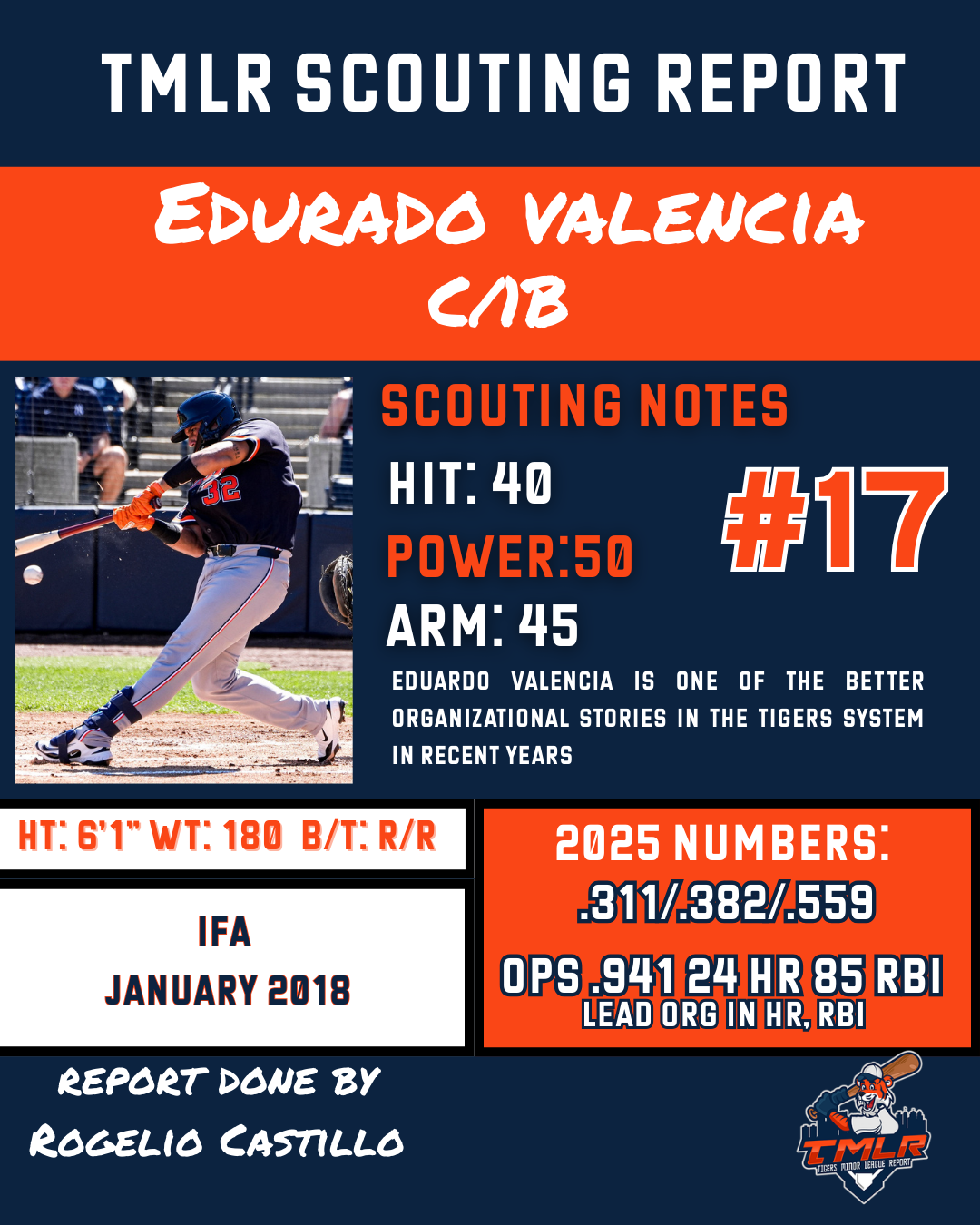
Background: A native of Valencia, Venezuela, Eduardo Valencia signed with the Tigers in 2018 as a teenage catcher and spent most of the next six years looking like organizational depth at best. He bounced around the lower levels, never played more than 62 games in a season, and was still at Single-A Lakeland at age 24 — three years older than the average Florida State League player. Nobody had him circled. Then 2025 happened. Valencia set a simple goal heading into the season: finish at Triple-A. He did that and then some, splitting time between Erie and Toledo while posting a .319/.399/.622 line with a 90.7 mph average exit velocity, a 49 percent hard-hit rate, and a cycle on Aug. 8 in Toledo. The Tigers added him to the 40-man roster in November rather than risk losing him in the Rule 5 Draft. Spring training 2026 has added more texture to the story — a two-run homer off a slider on Feb. 26 with a 97.5 mph exit velocity, followed by a game-tying sac fly in the ninth inning on March 1 — though a left quadriceps injury slowed him early in camp. He enters 2026 as a 40-man depth piece behind Dillon Dingler, Josue Briceño, and Thayron Liranzo, with his most realistic near-term role tied to how convincingly he can close the defensive gap.
Physical description: Valencia is listed at 6-foot-1, 180 pounds, right-handed bat and arm. He arrived in camp this spring noticeably leaner, having shed weight in the offseason in a deliberate effort to improve his athleticism and bat speed. The Tigers have taken notice — internally, the organization has been effusive in its praise of Valencia, noting that he has done everything asked of him and then some. That kind of buy-in from a player who spent years on the organizational fringe carries weight in a clubhouse.
Hit: 40
The bat speed was always there in flashes — it was the approach and the body that weren’t. Valencia came into 2025 having worked with Erie hitting coach C.J. Wamsley on pitch selection, but the weight he shed this past offseason has been the quiet accelerant. A leaner frame allowed his hands to get through the zone faster, and the improvement showed up immediately in how he handled velocity. He finished 2025 with a 74.4 percent contact rate and a 25.6 percent chase rate. The only real flaw was modest struggles against quality breaking stuff once pitchers figured out that throwing him fastballs was a bad idea. For a 26-year-old who never hit above .270 as a pro before 2025, the jump was legitimately dramatic. The question is sustainability against a full season of major league scouting reports.
Power: 50
This is the tool that moved the needle organizationally. A .303 ISO in 2025 with 19 barrels across both levels is legitimate impact power, not empty slugging. He hit left- and right-handed pitching well, drove the ball to all fields, and the spring training home run off a slider on Feb. 26 — 97.5 mph off the bat — underscores that the lighter frame hasn’t cost him anything in the power department. If anything, the improved bat speed has made the power play up. The Tigers protected him in November partly because other organizations were eyeing that output. It’s a real tool, and it grades above average for a catching profile.
Run: 30
Valencia is not a runner, and the weight loss hasn’t changed that grade. He’s not going to hurt a team on the bases, but it’s not his game and it doesn’t need to be.
Defense: 30
This is the honest part of the report. Valencia’s defensive profile behind the plate — pop times, framing, blocking consistency — remains a work in progress, and the Tigers have been candid about that. What’s changed is the conversation around where he’s going long term. First base is increasingly viewed within the organization as his most likely landing spot, and that comes with its own set of adjustments. The footwork around the bag, receiving throws from different angles, the physicality of the position — those are areas that need fine-tuning, and Valencia has approached that work with the same willingness that has earned him praise from the front office. The tools are there. The reps just need to catch up.
Arm: 45
The arm is fringy but functional. Pop times sit at the fringe-average range, and he has shown the ability to correct mechanics quickly when given specific feedback — a trait that bodes well as he transitions more of his defensive focus to first base. Tomás Nido has been a resource for him in camp this spring.
Overall: Eduardo Valencia is one of the better organizational stories in the Tigers system in recent years — a player who spent the better part of seven years on the margins and forced the front office’s hand through sheer production and professionalism. The bat is real. The power is real. The weight he shed last offseason, and the bat speed that came with it, suggests the 2025 breakout wasn’t a fluke. The defensive home is still being sorted out, with first base the most likely answer, but the organization’s confidence in him stems as much from his character as his tools. He’s done everything asked of him. That matters. The 2026 season will determine how quickly the major league door opens.
 Chris Brown