

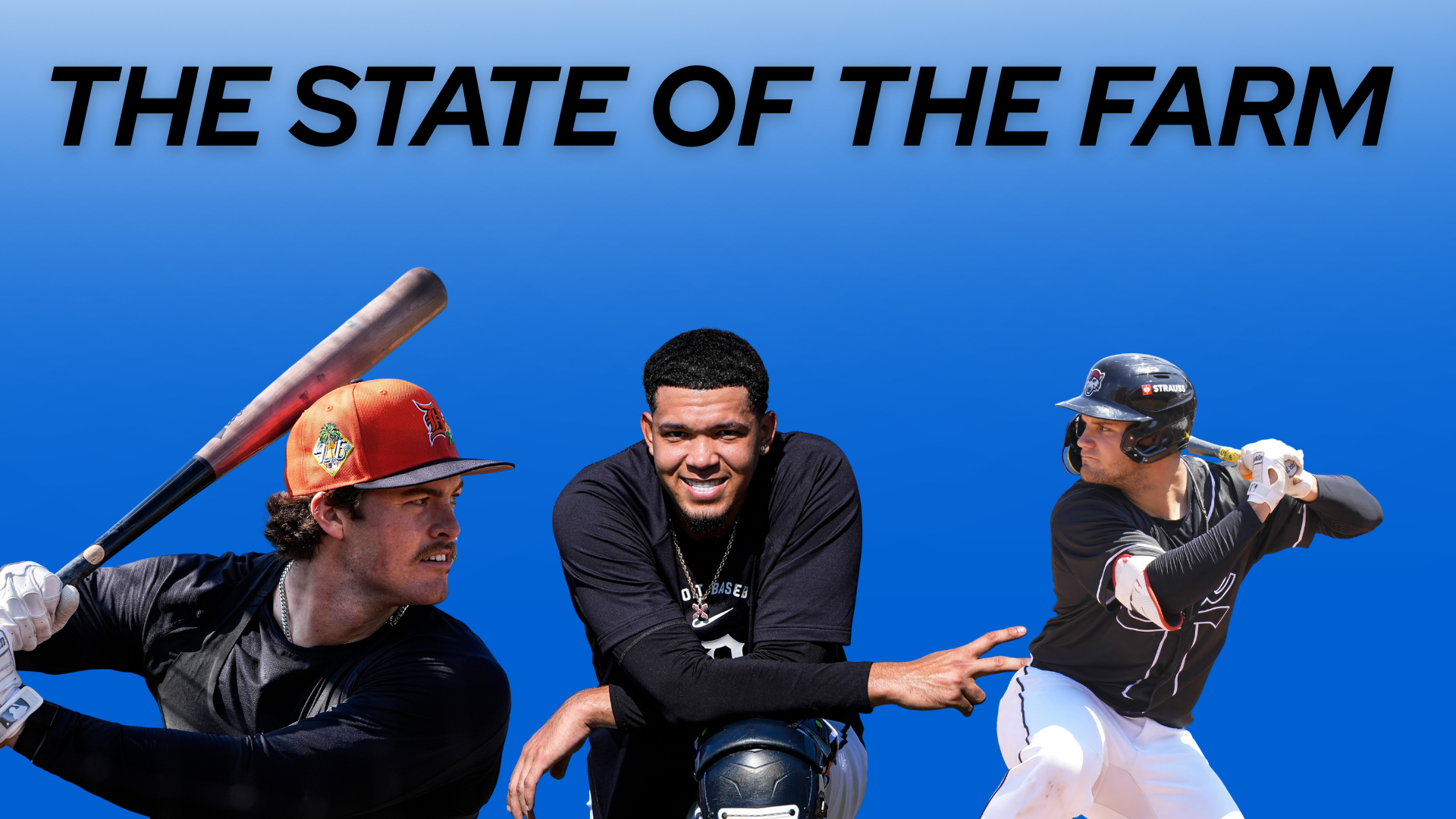
The Detroit Tigers’ farm system has reached the point every productive system eventually does.
The names are starting to graduate. The injuries are starting to pile up. The national rankings are beginning to thin out. And with Tigers Minor League Report’s next reranking only a few weeks away, this is a fair time to ask a simple question: Is Detroit’s farm system actually dropping off, or is this just what a good system looks like once it begins feeding the big-league club?
The answer is probably somewhere in the middle.
Baseball America’s most recent Top 100 update included only two Tigers prospects: outfielder Max Clark at No. 6 and shortstop Bryce Rainer at No. 71. That is a noticeable change from where Detroit was when Kevin McGonigle, Clark, Rainer and Josue Briceño gave the organization one of the more interesting prospect groups in baseball.
But farm systems do not stay static. If they are doing their job, players leave the list. That is what is happening with the Tigers.
McGonigle is no longer a prospect because he forced the issue. Jackson Jobe has already graduated. Dillon Dingler, Colt Keith, Parker Meadows, Riley Greene, Spencer Torkelson, Kerry Carpenter and others are reminders that Detroit has already pulled real big-league talent out of its system. The farm is not being judged in a vacuum anymore. It is now being judged after several of its best pieces have either graduated, gotten hurt or moved closer to the majors. That creates a different kind of evaluation.
A few years ago, the Tigers were still trying to prove they could build a pipeline. Now they have to prove they can sustain one.
The Tigers are producing positional players…finally
The strength of the system remains on the position-player side. Clark is still the headliner, and there is no reason to overreact to the normal bumps that come with development. He remains an elite athlete with center-field traits, strike-zone awareness and the kind of all-around profile that can still make him an everyday player in Detroit. MLB Pipeline currently lists Clark as Detroit’s No. 1 prospect and has him at Triple-A Toledo with a 2026 estimated arrival.
Rainer gives the organization another high-upside left-handed bat with arm strength, physicality and defensive value. Pipeline has him as Detroit’s No. 2 prospects list him at High-A West Michigan, which is an important checkpoint for his development. His early time with the Whitecaps has already included some encouraging flashes, including his first High-A home run during West Michigan’s loss to Dayton on Wednesday.
Briceño, when healthy, still has one of the more interesting offensive profiles in the system because of the bat speed, power potential and defensive flexibility between catcher and first base. Max Anderson’s performance and proximity matter. Hao-Yu Lee, when healthy, still offers offensive ability and defensive versatility. Thayron Liranzo remains a switch-hitting catcher with power. Cris Rodriguez, Jordan Yost, Anibal Salas, Jesus Pinto, Brett Callahan and others give the lower levels some intrigue.
The weakness is just as clear: the Tigers’ system is not as deep in impact pitching as it once appeared to be. Detroit has not developed many international arms into major-league contributors in recent years, and the old cliché of the organization leaning on SEC pitchers in the draft does not carry the same weight when the upper-level pitching depth is this thin.
Some of that is natural. Jobe graduated. Troy Melton reached the majors, got hurt and is now working his way back. Sawyer Gipson-Long already has big-league time. Andrew Sears has been injured. Jaden Hamm has been working back. Garrett Burhenn is out for the year. Essentially, Erie down three starters but has been able to turn things around.
But the frustration is not limited to the upper levels.
The Tigers also have lower-level arms who either have not been on the mound enough or have not moved quickly enough to change the larger perception of the system. Ethan Schiefelbein has dealt with injury. Michael Massey, one of the more interesting arms from the 2024 draft class, has yet to pitch in an official game for the organization. That does not erase their talent, but it does delay the answers. And when a system is already light on upper-level pitching, those delays become louder.
Ben Jacobs and Malachi Witherspoon, both from the 2025 draft class, have shown promise. Jacobs has already given the organization some encouraging signs, and Witherspoon’s latest start was the kind of outing that reminds you why the Tigers were interested in him in the first place. He went five innings, allowed three hits, one run and one walk, and struck out a career-high 10 while generating 22 whiffs on 40 swings. That is real swing-and-miss production, and it is one of the more encouraging lower-level pitching performances in the system this season.
Melton’s rehab start Sunday was a reminder of both the upside and the delay. He went 1 2/3 innings, allowed two runs, one earned, and showed encouraging stuff, including a 97.2 mph average fastball and three whiffs on five swings with his slider. That is a positive sign. It is also not the same as having him fully stretched out and helping Detroit right now.
Sawyer Gipson-Long also needs to be evaluated in the right category. He can still help the major-league club. He has already pitched in Detroit, he is on the 40-man roster and he provides needed depth. But he should not be treated the same way as a traditional prospect anymore. At this point, Gipson-Long fits more as a major-league depth arm than a rising farm-system piece. That does not make him unimportant. It just changes the bucket he belongs in. He has pretty much graduated.
That distinction matters. Gipson-Long can be useful without being a major part of the farm-system ceiling. The Tigers need arms like him because a season always tests depth. But when evaluating the health of the farm, he belongs more in the “can help Detroit survive innings” category than the “next wave is coming” category.
West Michigan’s Outfield
On paper, High-A West Michigan should be one of the more interesting checkpoints in the organization. It is usually where the Tigers start getting real answers on whether lower-level athletes and projection bats are turning into actual prospects. Instead, the Whitecaps’ outfield picture has been messy.
Roberto Campos coming back to West Michigan after being in Erie is not automatically a death sentence for his prospect status, but it is a form of regression. Campos was once one of the more recognizable international names in the system, and at this stage, the Tigers would have preferred him forcing the issue in Double-A instead of needing more time in High-A.
The bigger issue is not just Campos. It is what his return says about the layer of depth around him.
West Michigan has had to lean on older players, organizational depth types and independent-ball additions to get through the season. There is nothing wrong with that from a player-development standpoint. Every affiliate needs stability. Independent-ball players can absolutely help a minor-league roster function, and many of them deserve those opportunities. But when a High-A club is relying heavily on those types of outfielders, it is also a sign that the system is not overflowing with young, high-upside outfield bats ready to take those plate appearances. The Whitecaps have lost 11 in a row.
That matters when evaluating the Tigers’ farm as a whole.
The organization still has outfield upside. Clark is still the obvious headliner. Rodriguez, Salas, Pinto and Callahan give the lower levels some athleticism and projection. But there is a difference between having interesting names and having a fully formed wave. West Michigan shows that gap. The Tigers have outfield talent, but not all of it is close, and not all of it has separated yet.
The same idea applies on the pitching side with Rayner Castillo.
Castillo still has age on his side, and there is no reason to close the book. But the growth has not been as clean as expected. At this stage, he has not made the jump from “interesting arm” to “clear future big-league starter.” In a deeper pitching system, that would be easier to absorb. In this Tigers system, where upper-level pitching depth has already been thinned by injuries, graduations and performance questions, his lack of a step forward stands out more.
That is probably the broader theme with the system right now. Detroit has talent, but some of the talent is either hurt, repeating levels, aging out of prospect status or still too far away to carry the overall ranking. That does not make the system bad. It makes it more fragile than it looked when McGonigle, Clark, Rainer and Briceño were all healthy, eligible and grouped together near the top of national lists.
The Tigers have been here before
The Tigers’ current system has already produced enough big-league talent that a dip in prospect rankings should not be treated as panic. But the next wave may not be as strong as the McGonigle-Clark-Rainer-Briceño wave, at least not yet.
A good farm system is not supposed to have four Top 50 prospects every year. That is unrealistic. But a strong organization should keep producing contributors, even when the star power fades. For the Tigers, the next TMLR reranking should probably reflect that. Hell, after our top 10, all of our lists are up in the air.
Clark remains the clear top prospect. Rainer still belongs near the top because the upside is too large to ignore. Briceño should not be buried because of injury, but the missed time has to be acknowledged. Anderson’s performance and proximity matter. Liranzo’s power and his ability to hit is what the Tigers are banking out. The lower-level outfield group, including Rodriguez, Salas, Pinto and Callahan, gives the system some needed athleticism and upside. The pitching group needs more separation and better health.
That is the state of the system in one sentence: Detroit still has talent, but the margin for error is smaller than it was six months ago.
The Tigers are not staring at an empty farm system. They are staring at a farm system where the star power has thinned, the injuries have exposed the depth and the next wave has not fully separated yet.
That transition can be healthy. It means McGonigle graduated. It means Detroit is pulling players to the majors. It means some of the rebuild’s promises have turned into big-league reality.
But it also means the next wave has to do more.
The Tigers need Clark to keep pushing toward Detroit. They need Rainer’s bat to make the expected jump. They need Briceño healthy. They need Anderson, or an outfielder to emerge. They need one or two pitchers to change the conversation. And they need the lower-level names to start turning tools into production.
Building a farm system is one thing. Keeping it strong after the best players graduate is another. The Tigers have made real progress in the first category. The next few months will tell us more about the second. Keep the development machine rolling.
Follow me on “X” @rogcastbaseball
 Chris Brown
  Ashley Couturier
  Jerry McKennan