

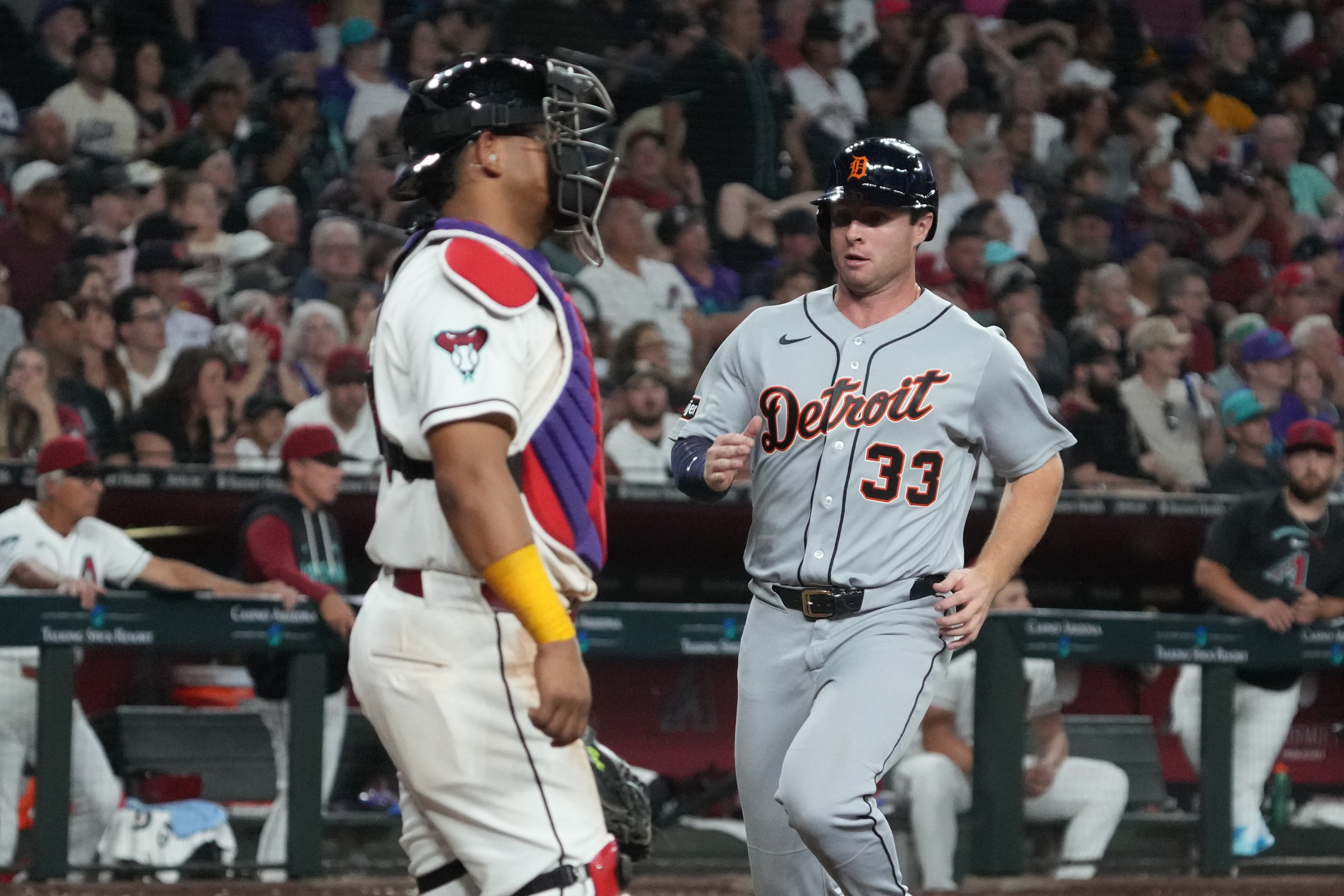
Through four games of the 2026 season, Colt Keith is doing exactly what the Tigers — and the underlying metrics — said he was capable of. The 24-year-old third baseman is slashing .429/.500/.643 with a 1.143 OPS, six hits in 14 at-bats, two doubles, two RBI, and a 12.5% walk rate. The surface numbers are impressive enough on their own, but the Statcast data behind them tells a more interesting story — one that has been quietly building since last August.
The Bat Speed Leap Seems Legit
The single most important data point from Keith’s early 2026 Statcast profile is his average bat speed: 73.5 mph, up from 70.7 mph in 2025 and 71.3 mph in his 2024 rookie season. That jump puts him noticeably above the MLB average of 71.7 mph and ranks in the upper tier of the league. More telling is his fast swing rate: 37.0% in 2026, compared to just 10.0% in 2025 and 14.3% in 2024. The league average sits at 23.6%.
The Statcast bat speed distribution chart from Baseball Savant makes this visually undeniable. The 2025 bell curve (orange) clustered around 65-68 mph and was concentrated tightly. The 2026 curve (green) has shifted meaningfully to the right, peaking around 73-75 mph, with a longer tail extending toward 80+ mph. That rightward shift isn’t a fluke of four games — it reflects a physical and mechanical change that appears to have carried over from the offseason.
His swing length also ticked up slightly to 7.2 feet (from 6.8 in 2025), and while his squared-up contact rate is only at 36.4% through the small sample, the “Blasts” metric — Statcast’s measure of elite contact combining bat speed and squared-up contact — shows 14.8% of his swings qualifying, above the 10.7% league average.
The Batted Ball Profile: The Power From the Minors Is Coming Out
Keith’s Statcast batting statistics through four games paint a picture of a hitter whose power is starting to match the bat speed. His exit velocity sits at 94.1 mph on average, up from 90.0 mph in all of 2025 and 87.8 mph in 2024 — a two-year jump of more than six miles per hour. His max exit velocity has already hit 104.9 mph this season.
The barrel rate of 10.0% through 10 batted balls is a small-sample number, but it’s directionally consistent with the 2025 improvement. Last year he posted a 9.2% barrel rate and a career-best 43.7% hard-hit rate — the ninth-largest improvement in the majors. Those weren’t random; they were driven by the same swing changes now producing even higher exit velocities.
His xwOBA through four games sits at .502, with an xSLG of .559. His actual wOBA of .502 nearly matches the expected number, meaning he isn’t being carried by luck — the quality of contact is producing the results. His launch angle of 14.5 degrees keeps him in the sweet spot range, and the LA Sweet-Spot percentage of 40.0% is elite-level territory.
The Swing Path: Where the Mechanical Change Lives
The Statcast swing path data shows a subtle but meaningful shift heading into 2026. His swing tilt remains consistent at 32 degrees across all three seasons, but his attack angle has increased from 8 degrees in 2024 to 12 degrees in 2025 to 13 degrees in 2026. His attack direction has shifted to 6° pull, up from 3° pull in 2025 and neutral in 2024.
More significantly, his Ideal Attack Angle percentage — the share of swings in the 5-20 degree window most conducive to hard contact — has jumped to 59.3% in 2026, compared to 48.8% in 2025 and 45.3% in 2024. The MLB average is 50.9%. That number matters because it means Keith is more consistently getting into his optimal swing plane, which directly connects to the exit velocity and barrel rate improvements.
His batting stance data adds context: his competitive swings dropped sharply to just 27 through four games compared to 732 in all of 2025, which reflects the early-season sample, but his intercept point and depth in the box have stabilized — 7.9 inches from the front of the plate and 23.7 inches depth in the box — suggesting he’s found a more consistent setup than the 9-inch intercept point that defined his 2025 approach.
The Bigger Picture
Keith’s 2025 regular season produced a .256/.333/.413 line with a 109 wRC+ over 137 games — solid for a 23-year-old still figuring out his defensive home, but below the ceiling the Tigers paid for when they signed him to a six-year, $28.64 million extension before he’d ever played a big-league game. The power — projected as a 60-70 grade tool by scouts — wasn’t showing up consistently. His 13 home runs in 2025 were respectable but not what the underlying bat speed suggested he should produce.
The exit velocity progression (87.8 → 90.0 → 94.1) is the statistical thread connecting those lost home runs to what may finally be emerging. As MLB.com noted after the 2025 season, Keith ranked 14th in baseball in exit velocity improvement and ninth in hard-hit rate improvement year-over-year. The 2026 early sample suggests that trajectory hasn’t leveled off.
It’s four games. The Baseball Reference game log shows a line built on consistency rather than one explosion: 2-for-5 on Opening Day, 1-for-1 with a walk in game two, 2-for-3 with a key two-run double in game three against San Diego, then 2-for-5 with two doubles and two RBI in the Monday loss to Arizona. That two-run double in the seventh inning against Arizona was one of the Tigers’ few genuine rallying moments in a rough night. It’s the kind of situational damage a hitter produces when the bat speed and approach are aligned.
The Statcast numbers aren’t projecting a .429 hitter. They’re projecting something more realistic and more sustainable — a hitter whose bat speed jump, improved swing plane, and rising exit velocity suggest the power breakout Tigers fans have been waiting on since 2024 may finally be arriving on schedule.
 Tristen Kuhn
  Colin Arthur