

The Detroit Tigers Might Have Some Arms
We are somewhere between one and two weeks into the 2026 minor-league season. It’s far too early to make any sweeping declarations. But this 2025 Detroit Tigers draft class looks good.
Now, we have barely seen the two prep hitters the club drafted in the first round. Jordan Yost made a splash in his first spring at-bat, and Michael Oliveto looked impressive in our limited viewing at the Spring Breakout game. But Oliveto is now on the 60-day Injured List with a broken toe. And Yost, somewhat surprisingly, did not make the Lakeland Flying Tigers opening day roster.
But we have plenty of time to form opinions on a pair of teenage hitters. What we’re here to talk about today is Detroit’s crop of 2025 college arms. We had some concerns about the state of pitching in the organization last year. It seems like the Tigers did, too.
They drafted and signed 10 pitchers from the college and JuCo ranks last year. Three began the year on the injured list. Their 12th-round pick Cash Kuiper has neck inflammation. Joe Ruzicka (16th) is on the 60-day IL recovering from knee surgery, while Joey Wimpelberg (17th) should return relatively soon from elbow surgery. Their 20th rounder Kameron Douglas was a two-way player at Alabama State, and he is currently on the Florida Complex League roster.
That leaves us with six very interesting arms to discuss. But one last thing before we get into it. College arms are supposed to dominate in the low minors. Generally speaking, they are facing younger hitters who don’t have much of a chance to reach the big leagues.
Baseball history is littered with pitchers with amazing numbers in A-ball who then ran into a brick wall at higher levels. For the Tigers this includes players like Jon Connolly, Nate Bumstead, Jon Kibler, and Austin Kubitza. We may be seeing it now with Jaden Hamm, though TMLR remains hopeful he can figure things out this year.
So, while we’ll mention some numbers here, we’re going to focus on what we see. Let’s get to it.
Malachi Witherspoon – 2nd Round
What We See: Witherspoon made his pro debut with four solid innings in which he allowed just one run on three hits. He didn’t walk anyone, and he struck out four. His fastballs averaged 96 MPH, and he touched 98. And he broke out three different breaking balls, with his cutter and slider both looking like weapons. The best sign was probably that he needed just 52 pitches to complete four frames, and he threw strikes at a 63% clip.
What to Improve: Witherspoon looks a little reliever-ish. The strike throwing was a great first step, but he didn’t throw a single true offspeed pitch in this outing. There were a couple of curveballs at 82-83 MPH, but no changeups or splitters. Starting pitchers don’t necessarily NEED a changeup or splitter to succeed – Dylan Cease, Jack Flaherty, and Gavin Williams don’t really throw them. But it’s tough to consistently go deep into games without a true offspeed pitch. We thought it might be a development priority for Witherspoon over the offseason, but to see none in his first start suggests that perhaps he just doesn’t have the feel. We’ll see what happens in his subsequent outings.
Ben Jacobs – 3rd Round
What We See: There’s an awful lot to like here. Jacobs works from the extreme 3rd-base side of the mound and is an intense, demonstrative pitcher with a very lively fastball. In two outings this year he has managed to rack up 18 whiffs with his four-seamer alone. It sits at 94 MPH and touches 96, with a low release point and 18+ inches of induced vertical break, on average. He’s also getting a decent amount of whiffs with his mid-80s slider and his low-80s changeup. The changeup, in particular, looks like a potential plus pitch for him down the road.
What to Improve: We’d like to see Jacobs continue folding in the changeup, because he’s throwing it just under 14% of the time so far. He could also stand to hold his velocity a bit better. So far this year his fastball has averaged 94.8 MPH in the 1st inning, but by the 4th inning it’s down to 93.5. And we would like to see slightly better command in general so he can be a bit more pitch efficient. Right now he’s throwing about 4.67 pitches per plate appearance, which is quite high. For comparison, Freddy Peralta led all qualified MLB starters in 2025 with 4.27 pitches per plate appearance.
Caleb Leys – 4th Round
What We See: A solid four-pitch mix with good extension and an impressive compete level. Leys is the oldest pitcher we’re discussing today, mostly because he missed a year of college with elbow surgery. Nothing he does jumps off the page, but he knows how to pitch, and he managed to work around a fair amount of adversity in his first outing. He erased a leadoff walk with a nice pickoff throw, and he had to get five outs in the 2nd inning because two of his strikeouts also turned into a passed ball and a throwing error. But he finished strong, retiring the final five batters he faced on just 16 pitches.
What to Improve: Leys’ fastball sat at 92.5 MPH and topped out at 94.1 in his pro debut. That’s roughly average for a big-league lefty starter, but 50 of his 68 pitches (73.5%) of his pitches were four-seamers and sinkers. He’s probably going to need to throw his secondary stuff more often to find consistent success at higher levels. And it wouldn’t hurt to see the velo tick up a notch or two, but there’s plenty of time for that.
Grayson Grinsell – 6th Round
What We See: A whole lot of funk. Grinsell’s fastball sat at 91 MPH and topped out at 93.2. But it plays up a ton thanks to a fairly uncommon arm slot and 19 inches of IVB on average. He backs up the heater with a diabolical low-80’s changeup that drew 8 whiffs on 11 swings in his pro debut. Grinsell also threw 10 breaking balls, though neither his slider nor his curve was effective. He drew just two swings on the slider and didn’t land any of the other eight pitches for called strikes.
What to Improve: Finding more success with the breaking balls would help, for sure. But honestly, with Grinsell we just need to see him do this at higher levels. He’s exactly the sort of A-ball standout we mentioned earlier – a lefty with a funky delivery and a plus changeup. That’s pure poison to young hitters. Still, even if he runs into trouble at higher levels, his fastball/changeup combo might at least make him an interesting big league reliever.
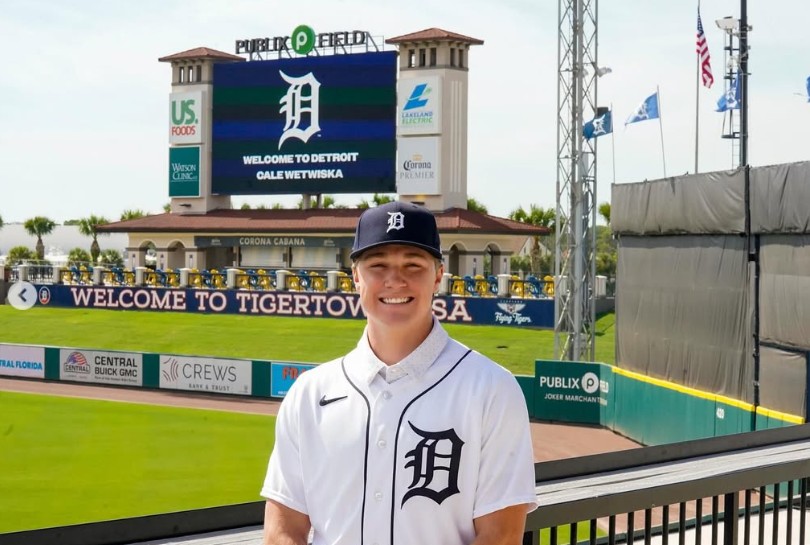
Cale Wetwiska – 7th Round
What We See: The next Troy Melton? We don’t want to set the expectations too high, or put too much pressure on this young man. But Wetwiska looks a lot like Melton did when he was in Lakeland in 2023. They were both relatively raw pitchers who leaned heavily on a mid-90s fastball with plus extension and solid IVB. Both had interesting changeups that worked well (though Wetwiska’s is currently being classified as a sinker) in small samples. And both made two appearances for the Flying Tigers in their draft year before beginning the following season in Lakeland. In Wetwiska’s case, we have already seen a substantial jump in stuff. His fastball averaged 93.6 MPH in 2025, and topped out at 95.8. In his first start of 2026 his heater sat at 95.5 and touched 98.1
What to Improve: As we said, Wetwiska is still raw. His breaking balls looked better on the back fields this spring, but he didn’t miss any bats with them in his first outing. And, much like Jacobs, Wetwiska will need to keep refining his command to get a little more efficient. He needed 68 pitches to get through 15 batters in his debut.
Charlie Christensen – 15th Round
What We See: Pitching development is just ridiculous these days. Charlie Christensen was a 15th round pick. He worked four perfect innings in his pro debut with a sinker that sat at 93.5 MPH and touched 96. He got six whiffs with his changeup and three more with his cutter. All seven of the balls in play against him were groundouts, with an average exit velocity of 68 MPH. He did all of this with a release point 4.5 feet off the ground and 7+ feet of extension, and he threw 33 of his 42 pitches (78.5%) for strikes. It was a remarkably impressive pro debut.
What to Improve: We have nothing. Do this again. And then keep doing it at higher levels. Christensen also has an element of the unusual arm angle + good changeup that we mentioned with Grinsell, so we don’t want to get too giddy here. But this looks like it might work.
So that’s it. Six very interesting arms from last year’s draft. History tells us injuries and/or ineffectiveness will claim a few. But this looks like a group that could produce multiple big leaguers, and do so relatively quickly. Be sure to keep track of these players with Jerry’s awesome Pitcher Cards over on our Patreon.
 Tristen Kuhn
  Colin Arthur
  Rogelio Castillo