

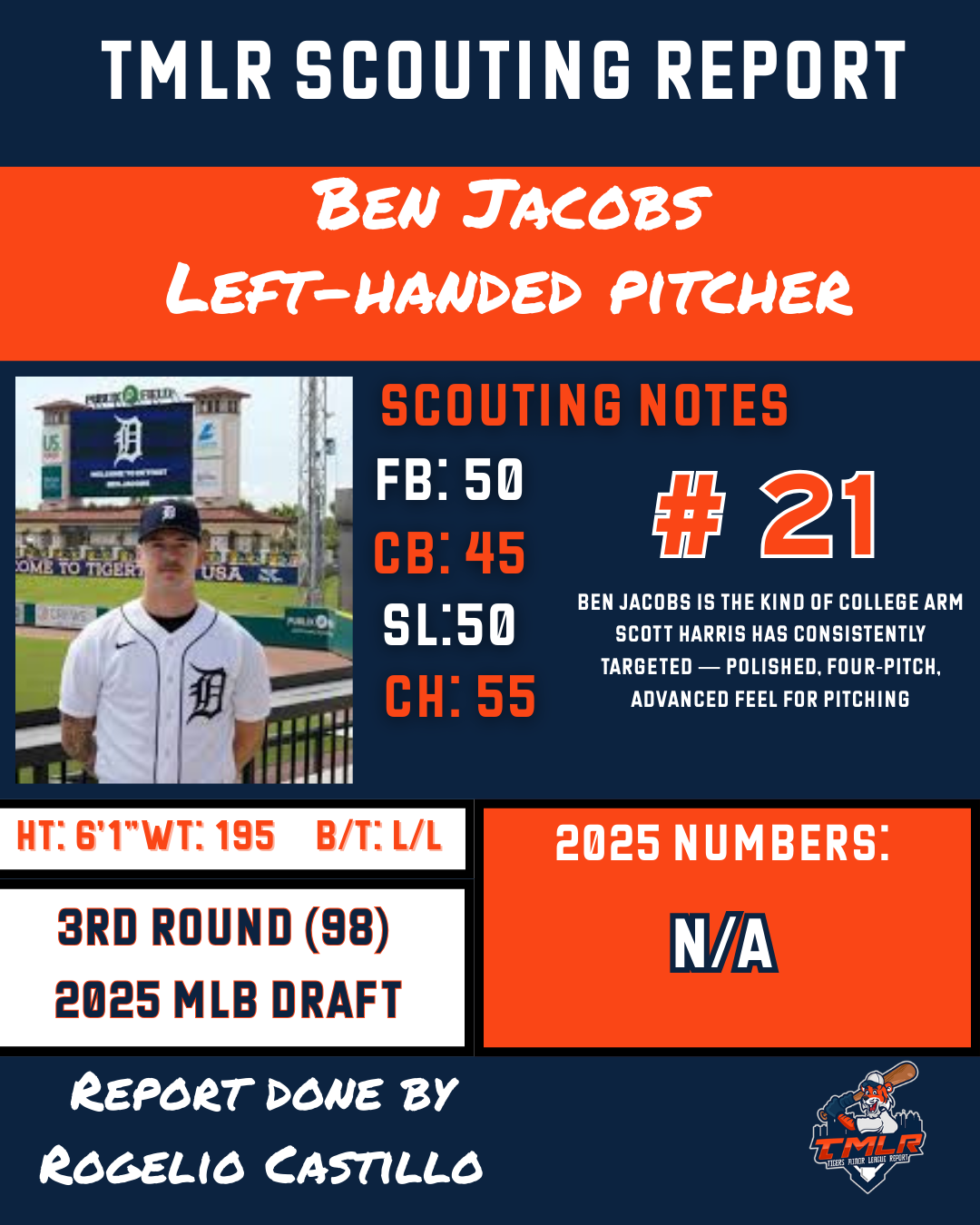
Background: A native of Fountain Valley, California, Ben Jacobs was a well-regarded prep arm out of Huntington Beach High School — a program with a long track record of producing professional pitchers — before committing to UCLA as part of the 2022 class. He threw just five innings in Westwood before transferring to Arizona State, where he reinvented himself over two seasons and grew into the Sun Devils’ Friday night starter by his junior year. The Tigers selected him 98th overall in the third round of the 2025 draft and signed him for $722,500 — roughly $60,000 under slot, which for a club that typically saves more aggressively with college arms signals genuine organizational conviction in the pick. He is listed at 6-foot-1, 195 pounds, left-handed on both sides, and turns 22 in June. His pro debut stats are not yet on file, with the organization expected to bring him along conservatively given his 83 2/3 innings logged at Arizona State in 2025.
Physical description: Jacobs is a compact, physical lefty with a prototypical collegiate starter’s frame. There is not a lot of projection left physically — what you see is close to what you get in terms of size and build — but he carries his weight well and his delivery is clean enough that the Tigers are optimistic about what minor mechanical refinements can unlock in terms of stuff consistency. The frame is durable. The arm works.
Fastball: 50
Jacobs sits in the low 90s and touches 95 with above-average riding life generated partly from solid extension out front. The carry through the zone is the carrying quality of the pitch — it plays up beyond the velocity reading and generates swing-and-miss at the top of the zone when he locates it well. The inconsistency in his junior year at holding that ride from start to start was part of what pushed him into the late third round rather than higher. The Tigers believe cleaner lower half mechanics will help him hold 94 mph more consistently as a professional.
Slider: 50
His primary breaking ball operates in the low 80s and flashes two distinct looks — a harder version with late glove-side cut and a softer, slurvier shape he can hang in the zone for strikes. Both versions generated swings and misses in college and give him a weapon against left-handed hitters in particular. The pitch needs sharper, more consistent execution to become a reliable out pitch at the upper levels, but the foundation is there.
Curveball: 45
The upper-70s curve gives Jacobs a third look and a speed differential he can use to steal strikes early in counts. It is the least refined of his three secondaries and more of a developmental pitch at this stage, but the feel is real and it rounds out a four-pitch mix that profiles as a legitimate starter’s arsenal if the command tightens.
Changeup: 55
This might be Jacobs’ best pitch in a vacuum. He does a nice job killing spin on it, and it generated a 52 percent whiff rate (per Baseball America) against right-handed hitters at Arizona State, a number that held up across multiple seasons and speaks to genuine feel rather than sample-size noise. The Tigers view the changeup as the equalizer that makes him viable against a lineup the second and third time through, which is the central question for any back-end starter profile.
Control: 45
Jacobs is a good strike thrower who needs more precision, not more strikes. He repeats his delivery well in general but will occasionally lose his landing spot and roll off his lead foot, costing him command to his arm side.
Overall: Ben Jacobs is the kind of college arm Scott Harris has consistently targeted — polished, four-pitch, advanced feel for pitching, with enough projection remaining in the stuff to dream on more than what the surface numbers suggest. The ceiling is a mid-rotation lefty if the command takes a step and the fastball holds its carry more consistently. The floor, given the changeup and the pitchability baseline, is a swingman or long reliever who earns his roster spot by throwing strikes and sequencing well. The Tigers want to see him get to 100 innings in his pro debut and graduate through Single-A by the end of 2026 — an aggressive but realistic timeline for a college junior who was one of the Pac-12’s better starters. With the system’s pitching depth taking hits from injury in recent years, Jacobs is exactly the kind of safe, moveable arm that quietly fills gaps. His path to Comerica Park runs through command refinement and nothing else.
 Ashley Couturier