

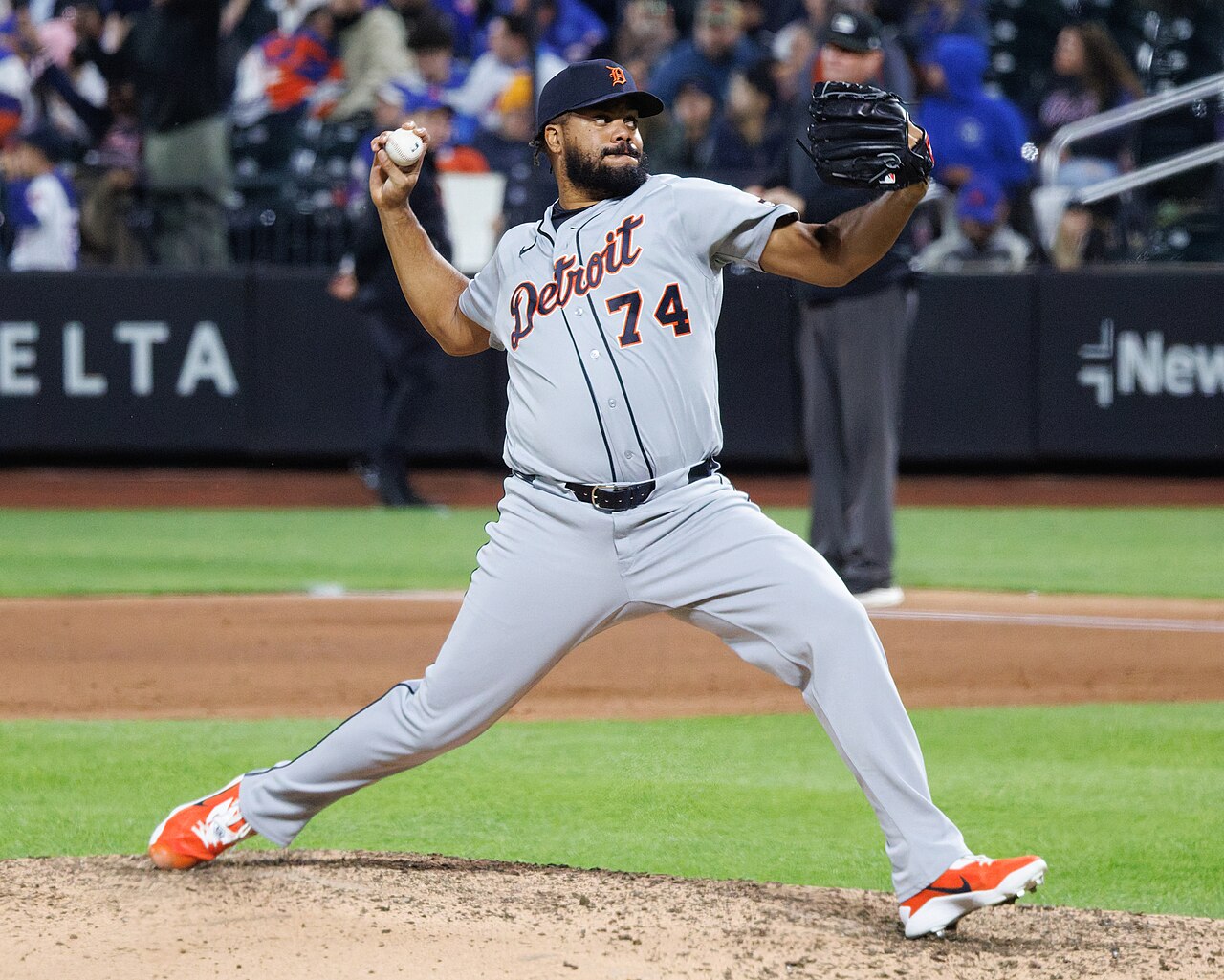
Kenley Jansen’s Untimely Year
Jansen spent 12 seasons pitching in Chavez Ravine for the Dodgers, ten of which he was a closing pitcher. The 39-year-old Jansen bounced between the Braves, Red Sox, and Angels after leaving the Dodgers following the 2021 season. Despite showing signs of regression in the last few years, Jansen has never had a bad season. His highest ERA in a season was in 2021 with the Dodgers, where he had a 3.71 ERA in 63 innings, securing 33 saves.
Coming into 2026, Jansen’s career ERA was 2.57 in 927.1 innings pitched. The Tigers chose to sign him to a one-year, $9 million deal for the 2026 season, with a club option worth $11 million for the 2027 season. The Tigers do not have to pick up this club option, and instead can buy out Jansen for $2 million.
The Tigers enter free agency with Gleyber Torres, Jack Flaherty, Justin Verlander, Tarik Skubal, and Casey Mize’s contracts off the books. This is a little over $80 million freed up on the payroll, in addition to tens of millions of dollars shy of the luxury tax. This financial freedom allows the Tigers to make a decision based on Jansen’s performance on the field, rather than for contractual reasons.
Kenley Jansen Deep Dive
Kenley Jansen, at the surface level, had a fine season. But digging deeper, his season was marked by a lack of consistency and untimely blown games. Jansen had a 3.20 ERA in 45 innings, which is not awful, but he was 22-for-28 in save opportunities, a 79% rate. For comparison, Francisco Rodriguez was 44-for-49 in save opportunities for the Tigers in 2016, but had a 3.24 ERA. It seems that when Jansen gave up a run, it came at the worst possible time.
On April 24th, Jansen was one out away from his seventh save of the year in Cincinnati, then Spencer Steer recorded a base hit, and Nathaniel Lowe followed with a two-run home run to walk it off. That was the first of five times he was walked off in 2026. In his very next appearance in Atlanta five days later, Ozzie Albies began the ninth inning with a leadoff walk. Matt Olson followed with a walk-off home run. It was later reported that Jansen had been battling right groin and abdominal issues during this stretch.
The next six appearances for Jansen were not only scoreless, but hitless as well. On May 24th, Jansen coughed up a three-run walk-off home run to Colton Cowser. These were the only runs given up by him all month, but the timing of it was inconvenient. The Tigers were feeling the recent losses of Tarik Skubal, Gleyber Torres, Kerry Carpenter, and Brant Hurter. The team also suffered a four-game series home loss to division rival Cleveland a week prior. This marked the eighth time in the month of May the Tigers bullpen coughed up the game-winning run to this point. They would go on to blow three more before June 1st.
Fast-forward to August 19th, the Tigers are one game back in the wild card race and are a little over two weeks removed from trading staples of the starting rotation, Tarik Skubal and Casey Mize. The team at this point was 9-7 in the month of August, including three straight series wins in the West Coast. The bullpen had erupted again the previous weekend when the White Sox visited Detroit. Kenley Jansen entered the ninth inning of a 3-2 ballgame in a getaway game in Pittsburgh, ready to put the Tigers a half-game back of the wildcard for the time being. Up to the plate with one out, Rafael Flores ties the game for the Pirates thanks to a solo home run. Two batters later, Brandon Lowe wins it on a home run to right field.
The timing of this blown save could not have been worse for the Tigers and Jansen. The team lost its next four games and finished the month of August 2-8. This would be the end of the woes for Jansen, though. He did not give up another earned run beyond this point. In his last 10.2 innings pitched, Jansen only allowed two hits and three walks. He punched out 11 batters, and had a 2.16 fielding-independent pitching (FIP).
Second Half Adjustments
Jansen did perform significantly better in the second half compared to the first half. During the first half, he had a 4.56 ERA in 23.2 innings pitched, saved eleven games, and gave up 1.9 home runs per nine innings (HR/9). Jansen saved 11 games in the second half, and his ERA was 1.69 in 21.1 innings. He sliced his HR/9 in half to 0.9, which accounted for fewer runs scored by opposing teams. Nearly two home runs given up every nine innings simply will not cut it as a big league closer. The difference between his first and second half performance can be attributed to the long ball, but Jansen did face injury hurdles. He spent 15 days on the injured list due to pelvic inflammation in late May and early June. Whether this issue persisted any further is unknown.
Save situations were a point of struggle compared to non-save situations. In save situations, Jansen’s ERA was 4.26, and his HR/9 was 2.2 in 25.1 innings of work. In non-save situations, Jansen’s ERA was 1.83 and his HR/9 sat at 0.5. Although his ERA in save situations was not ideal, opponents only hit .189 when Jansen came in to shut down the game.
As a matter of fact, Jansen did not allow many hits all season. Opposing batters hit .156 against Jansen in 2026, the fifth-lowest mark in his career, while his 12.8% walk rate was the third-highest in his career. In 45 innings pitched, only 24 at-bats resulted in a hit against the hefty right-hander. This resulted in 4.8 hits every nine innings (H/9). For comparison, San Diego Padres All-Star flamethrower Mason Miller had a H/9 of 4.76. However, Miller only gave up three long balls all year, while Jansen gave up seven in 25 fewer innings pitched. Twenty-nine percent of the hits off Kenley Jansen in 2026 were home runs. Add on 23 walks, and opposing teams will be a walk and a blast away from winning rather than the traditional bloop and a blast.
What to Do With Jansen
With everything laid out, is Jansen good enough for the bullpen, but not good enough for the closer role? Well, if Jansen becomes a setup man or a middle reliever, it would be the first time since 2011, when he was 23 years old. Setup men and middle relievers inherit more baserunners, which does not align with Jansen’s game. Tyler Holton, Kyle Finnegan, and Brant Hurter combined to inherit 98 baserunners in 2026, allowing 18 to score. This combined rate is 18.4%, while the league average was 31.6%. These players excelled at picking up the check for their fellow pitchers. On the other hand, 41.7% of baserunners inherited by Jansen scored. Much higher than the league average.
The Tigers have a tough decision to make. Does Scott Harris trust Kenley Jansen as the closing pitcher, or in the bullpen at all? Jansen finished his 2026 campaign strong, but the overall damage may be too much. If the club chooses not to pick up his $11 million option, who would be the replacement? Left-hander Adrian Morejon and right-hander Raisel Iglesias are unrestricted free agents and have been dominant in their bullpen roles with their teams in 2026. Another option for the Tigers front office would be to have a closer by committee, as it has in previous years. However, this responsibility would fall to AJ Hinch, who has not had a closer since August 2018, when he named Roberto Osuna closing pitcher for the Houston Astros. Current options for a closer committee are Drew Sommers, Will Vest, and, if willing, Kenley Jansen.
 Rogelio Castillo
  Tristen Kuhn