

The Tigers sit 13 games under .500 with a 52% chance at a top 6 pick & 6.42% chance at the first overall pick as I write this on the 6th following their walk-off loss to the Guardians. The Tigers despite being 13 under .500 could still make the playoffs, but every indication at the moment is that likely won’t be in the future cards. Looking to the 2027 draft, and this can all change with the new CBA, the Tigers are likely to land a top 8 selection, PPI pick for Kevin McGonigle winning rookie of the year (I hope he does at least), and a Comp A pick, which could leave the team 4 top 60 selections, and three inside the top 42. Obviously, this means less than other sports but we’ve seen Scott Harris manipulate the slot well during his tenure as the Tigers POBO and that capital would allow them to do the same. The Tigers have leaned on the side of prep bats, but we’ve seem them adapt their philosophy in 2026 taking RHP Cameron Flukey out of Coastal Carolina. The 2027 class looks to be loaded from top to bottom, and I’ll give a brief look at some names to track over the next 10 months.
“Consensus” Top 10 Prospects:
SS Dylan Seward, Norco HS (CA)
- The 5’11, 175 pound short stop has incredible tools and I’d imagine he’ll stay as the likely 1.1 candidate. The switch hitting shortstop is an elite runner, with likely 75+ run tools and he pairs with elite defensive film showing good feet, quick movements, and he has an ability to cover a ton of ground at the position with 70+ field. He’s a good hitter who takes a compact approach to the plate, quick fluid hands, and his swing is violent. Seward will chase, especially vs velocity, but he’s shown good raw power numbers and his bat speed has ranked highly from both sides. Seward can grow into his power, and he has a very moldable power projection due to his bat speed. Seward is a true 5 tool shortstop, and the Tennessee commit should be a platinum glove caliber shortstop.
SS Brendan Lawson, Florida
- Lawson slashed .312/.511/.699 with a 1.210 OPS, 11 doubles, 2 triples, 19 HR, 14 SB, and 53 BB to 46 K last year for the Gators. During his two summer league appearances he’s hit .336 with a .920 OPS, 20 walks, 26 strikeouts, and 4 HR in 33 games. The 6’3, 215 pound lefty has some incredible raw power and he’s a bat first short stop. Lawson understands the zone well, he’s aggressive early on to capitalize on mistakes, and he also does a great job in his approach with plus plus hands to work through the zone well. His stance is a little funky, and it could lead to some swing and miss concerns in the minors due to his toe tap and upright stance, but he shows full body power that can generate 30+ homeruns. He’s seen exit velocities north of 112 on a consistent basis with a peak of 115.7 mph. Lawson is an average athlete, he’s not an elite runner but is capable, and I have a question if he’ll stick at SS where he may end up at third base due to his plus arm but limited range.
RHP Dax Whitney, Oregon State
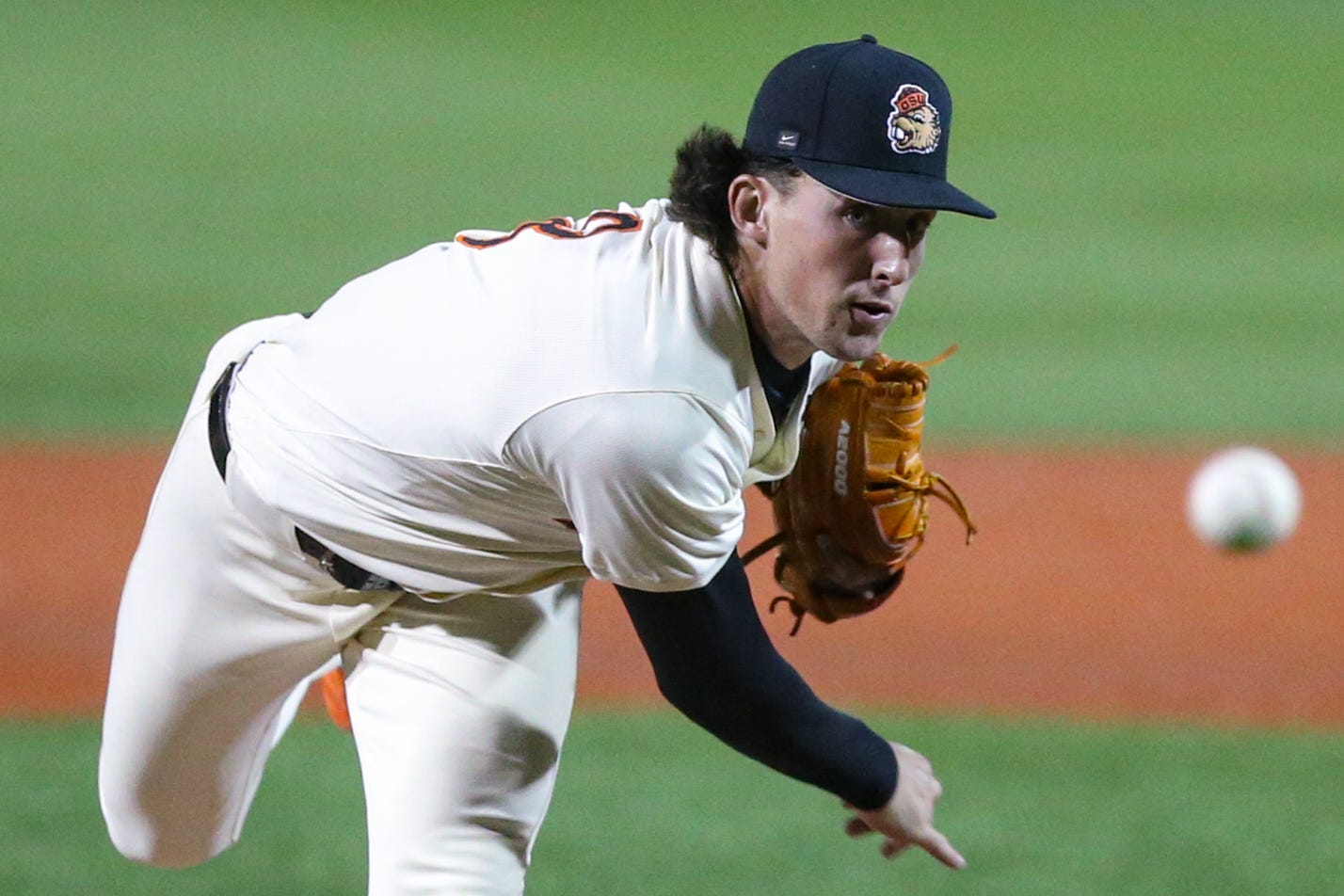
- Whitney will likely miss all of the next season recovering from Tommy John, though I expect him to maintain his notion as the top pitching prospect regardless. The 6’5, 218 pound righty has a wicked arsenal that’s led him a career 2.77 ERA over 139 2/3 innings with 224 strikeouts and 55 walks the last two seasons. Whitney has 4 50+ pitches headlined by a fastball that has sat 97-99 and touched 102, he throws from an upper 3/4 slot, where he hides the ball well and it explodes out of his hand with a ton of ride and late break including up to 23 inches of induced break. He pairs this with a cutter that has touched high velocities and he loves to use against righties in tune to north of a 35% whiff rate, and sub 40% contact rates on the pitch. He pairs the two fastballs with elite breaking arsenals including a 2-7 (like a clock) sweeper that generated a 52.4% whiff rate last year and sees over 15+ inches of movement. Lastly, Whitney ads a curve that has sat 78-80 and sees a true 12-6 shape with north of 2850 RPMs and touching 3000 at points. Whitney needs to refine the pitch and it’s hard to control it, but he controls the rest of his arsenal extremely well. Ideally he’ll be able to throw some bullpens before the draft to make sure his velocity remains, but Whitney’s stuff is truly 4 55+ pitches and there’s a chance he can fast track to the MLB should he recover well.
C/2B Gavin Kelly, West Virginia
- Kelly has a stout frame at 5’11/175 and the righty is coming off a 2026 season with a .383/.477/.725 line good for a 1.202 OPS, 21 doubles, 4 triples, and 19 home runs while posting 45 walks and strike outs. He’s played both second and C, though I’d imagine his future is likely at second as his framing & pitch calling need issues. He’s a good athlete, and while not a plus runner, there’s no questions on if he’ll be able to defend at either spot athletically, with likely above average range at 2B longterm and a plus arm. After struggling in 2025 with a .797 & a .684 OPS in the summer circuit, Kelly saw a breakout season. His approach remained the same, and Kelly does understand the zone well. His advanced numbers are exceptional with a high pull rate, especially in the air, and Kelly ranked near the top of the B12 and NCAA in ground ball rate (barely hits any). He’s seen his bat speed tick up, but there’s a chance it can tick up more which would unlock more power in his profile as well. Kelly is an interesting projection, his swing is advanced, and he has natural under the hood tools that indicate he’ll be able to grow into near 20 HR power to pair with surrounding tools.
OF Landon Hairston, Arizona State
- Hairston got to Tempe and has not stopped hitting including a .400/.509/.860 line in 2026 with 20 doubles, 28 HR, 11 stolen bases, 44 walks, and 27 strikeouts to pair with his 1.368 OPS. As a freshman, the 5’11/195 lefty hit .333 with a .908 OPS and 35 walks to 23 strikeouts. Hairston has a stout stance at the plate, he’s got lightning quick hands, and his swing is pretty similar to that of Max Clark but there’s more raw power in his profile. Hairston elevates the ball a lot, and he should naturally continue to keep his power as he advanced into the professional circuit. He’s a very patient hitter, who understands the zone and ranked in the 97th percentile for contact among all college hitters, while having a sub 10% strikeout rate. Hairston has a natural 60+ hit tool, if not better, and his power will develop as well with a frame that can likely add a bit more mass. He’s a corner outfielder, as a good athlete, but not elite, and there’s also some concern about his arm that doesn’t show a ton of true upside. Hairston will not be a liability in the outfield, but he projects as a top of the lineup caliber bat.
LHP Tomas Valincius, Mississippi State
- Mississippi State has an absurd rotation this year, with three pitchers likely to hear their name called in the first round of the 27 draft. Valincius, the 6’2/225 lefty transferred in from Virginia and posted a 3.5 ERA, 135 strikeouts, and 20 walks in 97 2/3 IP last year on pace to an 11-2 record and 1.07 WHIP. Valincius can be subject to the long ball allowing 15 home runs last year, but his arsenal shows front of the rotation potential. He’s a stocky pitcher, throwing from a low arm slot that hides the ball, and makes him hard to pick up quickly. He’s gotten good extension, is quick to the mound, and he headlines his arsenal with a 94-96 fastball that has touched 99 before. It gets a lot of glove side run, and there’s some concern over it’s ability to rise but he is able to locate well and it moves with good velocity to be north of a 30% whiff rate. He pairs this with a tight sweeper that sits north of 2700 RPMs and in the 84-87 range, he controls the pitch well and loves to throw it early on in counts in tune to a 48% whiff rate. His changeup is a kick change but doesn’t drop much and it has some questions with the tunneling to the fastball due to his fastball’s lack of rise. The lefty pounds the zone, has good swing and miss potential, and he works extremely effectively vs righties.
RHP Chris Levonas, Wake Forest
- Levonas is next in the Wake Forest pitching factory, after a 2026 season where he posted a 2.82 ERA, 10-3 record, 116 strikeouts, 1.05 WHIP, and just 33 walks in 73 innings pitched. Levonas is slightly undersized at just 182 pounds and 6’2, and the former Brewers 2nd rounder has only gotten better over time. He’s a bull on the mound, and he will fill up the strike zone consistently. Levonas has a fastball that has sat 96-99 and touched 102 with above average rise and a tendency to run into lefties though it’s inconsistent that late, but he commands the pitch well and used it to a near 35% whiff rate last year. Levonas has elite secondary pitches with a mid 80’s sweeper and nearly 50% whiff rates though he’s shown some issues with controlling it down where it can hang over the middle of the plate. He also features a looping curveball that gets 30%+ whiff rates and his changeup is coming along though it has a great movement profile but poor command. He can add more mass to his frame, though I’d like to see his windup changed a bit. He generated nearly 7.3+ feet of extension, which makes him tough to pick up but he’s susceptible to runners due to his leg kick and he can spray the ball as well with long arm action that can come behind his shoulder and cause hitters to pick up the ball at times. He’s a very projectable pitcher, with elite stuff, and if his mechanics are refined, he has ace like potential.
C Trent Grindlinger, Tennessee
- Grindlinger is a physically dominant 6’3/215 pounder and the righty is coming off a 2026 season where he logged a .986 OPS and a .345/.414/.572 line with 8 home runs, 7 doubles, but 13 walks to 28 strikeouts. He has an open stance, but lightning quick hands, and incredible lower body/core strength that allows him to put his full strength into the ball and generate some intriguing power. He’ll hit across the field, and pulling the ball needs to be in his profile more often to truly tap into his power, and there is some ground ball concerns as well but he scorches the ball. Grindlinger has good contact rates north of 90%, though there’s some really big swing and miss concern especially vs velocity, and he’ll expand the zone quite often as well though he’s routinely made contact. The longterm profile interests me, where Grindlinger may be a future first baseman or third baseman. He’s an average athlete, but has a 55+ arm with good framing. If Grindlinger can hone in his aggressive approach, and start to capitalize more in the zone with his contact rates he should go high, especially at just 21 years old.
SS Graham Houston, Venice HS (FL)
- The 6’1/175 pound righty is committed to LSU, and he could be one of the fastest risers in the class. Houston is the brother of Marek Houston, the Twins first rounder in 2025. He’s got a good frame, but can and certainly will be asked to add more weight to tap into his power. His bat speed is elite, and near the best I’ve seen from most high school prospects, with elite contact skills as well that project him to have a very intriguing hitting skillset. His swing is quick, he shows a great understanding of the zone, and he’ll make a ton of contact which elevates how interesting his hit tool is as well. Houston has shown good exit velocities with plus bat speed which should allow him to grow into his power over time. He’ll grade out likely 60+ in terms of defense where he’ll stick at shortstop and his arm is among the best in the prep class as well, though I do wonder how much stronger it can get over time. Houston’s biggest concerns have come with the lack of power, though under the hood he should be fine in that department, and while he’s rangy I don’t love his overall run tool either. He’s shown more swing and miss from the left side, and there’s a chance a team asks him to become a full time righty as well.
SS Carter Hadnot, Aquinas HS (CA)
- Hadnot is a glove first prospect who also features possible 60+ run, glove, and arm tools though the hit and power are behind. An older prospect, he’ll be 19 during the draft, but he’s got a good physical profile as well at 6’2/175 that can hold more mass. Similar to others above, his bat speed has ticked up well recently, which can project into more power, though the hit tool does have some concerns as well. He’s a switch hitter, and should stick on both, but the power is far better from the left side with a better eye from the right side. Hadnot has a quick stance, there’s a good bit of moving parts, but he moves in unison and does a good job driving his legs to generate power and some intriguing exit velocities. He’ll stick at SS most likely, but can move to 3B with a good arm though his range is elite, and he pairs with the plus movement skills as a runner. Hadnot is an older prospect, and taking a step in the hit tool this year will be crucial, especially with some good swing and miss concerns.
Other Prospects, Riser Candidates
C/3B Jimmy Janicki, Troy
- The 6’4/225 rightly is a bat first prospect but I’m very interested on him defensively. He started playing catcher in 2026 and was better than expectation, with a plus arm, good athletic tools, and he’s shown an ability to frame the ball better than you’d expect. As a freshman he was a capable third baseman, and he may shift back especially with his arm strength and above average athleticism. Janicki has consistent exit velocities north of 115 mph and he’s reportedly hit a ball north of 118. There’s a lot of ground balls in his profile, along with higher than ideal chase rates, but he makes pure contact in the zone, and his swing is quick which allows him to generate more power off his frame. Janicki posted a .343/.415/.664 line with a 1.080 OPS, 31 BB, 43 K, 26 doubles, and 21 HR last year where he’s continued to develop year after year and posted a .905 OPS with 8 BB to 6 K during his 2025 summer league appearance. Janicki has a unique swing, but he’s made contact, and he has a ton of raw power that should end up as a future 60+ grade. He’s an average runner, but it’s hard to deny pure power with at least average defense either at 3B or C.
OF Grant Westphal, Blue Valley HS (KS)
- Westphal is someone I think can rise quickly, and might be a Tigers target. the 6’2/205 lefty has five tool upside, a very loud swing, but a lot of raw power as well. He’s grown into his frame, and likely can continue to grow more with elite bat speed for a prep kid. He’s shown plus run, and while having average to below arm strength he grades out as a 55+ defender that can stick in center and he has a knack for the ball gap to gap. Westphal needs to clean up his swing, and it will get picked apart at the MLB level, where I’d also like to see him be more unison to tap into his power more often.
C/1B Chase Fralick, Auburn
- A likely first baseman, Fralick has a ton of power and he also has a knack for the strike zone as well. The 6’2/230 lefty has shown improved defense behind the dish, there’s some athleticism concerns, and he’s shown an ok ability to frame. If a team believes in him as a catcher, he can go high off the pure bat that helped him to a .314 average & 1.069 OPS in part to 20 doubles and home runs last year. He’s fluid, uses his core well, and keeps his hands tight and high to come down on the ball, which creates loud contact. His ground ball rates were exceptionally low, and he shows a good ability to command the zone, not expanding vs spin which is crucial and he’s hit over .270 on Friday nights. I’d like to see him pull the ball more, and he’s likely a first baseman at the end of the day but the raw 55+ future values in his hit and power tools make him incredibly intriguing. There’s a world he can play 3B as well, though with below average athleticism it’s difficult to project despite a good arm.
SS Adrian Rodriguez, Texas
- Rodriguez despite a good frame at 6’2/200 doesn’t have much power, and is a true hit/glove first short stop. He has a quick swing, good stance, and the switch hitter does project to stick in that mold. He’s an elite runner, with an ability to swipe 25+ bases in the MLB, and he controls the zone exceptionally well with a career .414 OBP across his first two seasons with the Longhorns. Rodriguez has quick violent hands, his swing overall is extremely fluid but aggressive, and he does have near 95th percentile bat speed in the SEC which could tap into more power especially with higher pull rates. Rodriguez will flow quickly through the minors with his hit tool and elite glove that shows good range and a very strong arm, which could push him to 3B or 2B. He’s an interesting profile, and is very toolsy, with the power having some interesting metrics.
SS Lubin Rincon, Shadow Creek HS (TX)
OF Jacob Seamon, Metrolina Christian HS (NC)
- There’s a very real world Seamon ends up a top 5 pick in the 2027 draft. The 6’5/205 lefty will be just 18 on draft day, and he has a phenomenal overall profile. He’s a plus runner that has near 70 grade tools and he will stick in CF as well with a good glove. The frame can easily hold up to another 15-20 pounds which will tap into his power, though it will come at the cost of him likely moving to the corner with still very good movement skills. Seamon swings a lot, he makes a lot of contact, but he also chases a lot and was near the bottom of the summer circuit in strikeouts. He’s an elite athlete, who’s bat speed, size, hand speed, and strength project as a possible 35+ HR bat at the MLB level, though he’s going to need to change the swing and cut down on his strikeouts. His swing is very tall, with a long swing though he’s quick through the zone which generates good power, though it will be eaten up at high levels. Seamon has played SS as well, and his arm is good enough to stick there hitting 90+. The hit tool will be a concern, but overall his profile is fascinating from the left side.
1B Teddy Tokheim, Stanford
- Tokheim to replace Torkelson? The Stanford first baseman has played the outfield, but I expect him to move down to first longterm. He’s a very aggressive hitter but understands the zone, and will take his walks with good contact numbers as well especially vs spin. Tokheim has good power turning in 17 HR and a 1.118 OPS last year largely due to his quick swing and he uses his full core through the swing to help drive the ball to all parts of the field. His contact rates were extremely high, he’s able to play above average defense at first, but he’s going to hit as well. There’s a lot of raw strength in the right handed 6’3/220 frame but also good bat speeds and a ton of flyballs.
RHP Ryan McPherson, Mississippi State
- McPherson is smaller at 6’2/195 and he’s been hurt a bit which does concern me but he’s logged a 3.38 ERA, 107 K, 28 walks, and a 1.13 WHIP in 82 innings. McPherson’s fastball shape is impressive sitting 94-98 with up to 100 and it rises really well. He knows how to tunnel, and his windup does well to hide the ball as well, making him hard to pick up while also ranking in the 95th percentile for zone strike rate last year. He’s working on his secondary’s, though the changeup projects to be a plus pitch with great drop and high 80 velocity though he’s still working on the shape, and there’s a tendency for it to leak into the middle of the plate. His slider gets good break so does a curve, but both have some issues with their late movement and saw 35%+ whiff rates. I’d like to see him add another fastball to the mix to help take pressure off the slider that has gotten hit hard, but McPherson also needs to stay healthy.
RHP Duke Stone, Mississippi State
- Stone is a massive 6’6/240 and the righty has logged 7.4 feet of extension. His fastball gets a lot of movement with a 37% whiff rate and a lot of rise despite sitting 93-95, he’s seen his velocity rise over the last two seasons which could cause him to end up sitting more in the 94-96 range that increases his profile. His changeup is arguably his best pitch, and a true kick change that has nearly 12 inches of drop and saw a 55% whiff rate last year with good tunneling to the fastball creating a nice deceptive mix. He’s thrown a cutter, sinker, slider, and curve but nothing has stuck consistently, though the slider has good swing and miss potential to righties, and he’s shown an improved sinker over the last year. His curveball doesn’t break often, nor consistently, and it’s velocity is low which makes it a tough pitch though there’s some interesting facets with his ability to work it vs lefties. Stone gives up hard contact, but also gets a ton of ground balls, and he’s shown an ability to pound the zone with 88th percentile zone strike rates. He’s pitched to a 5.31 ERA, 107 strikeouts, 29 walks, and a 7-3 record across 79 2/3 last year. There’s a world he may end up a strong backend reliever, but the profile shows an ability to add more velocity, and also refined pitch shapes.
SS Chase Fuller, Lincoln HS (FL)
- The son of NFL DB Corey Fuller, he’s a very intriguing prospect I am going to end up much higher on than others. The 6’3/205 righty is committed to Florida State, where his dad does coach for the Seminoles football team and he may be a tough pull away as well. Fuller is very aggressive, but he shows a ton of contact in the zone, though he’s expanding far too often vs break and that hurt him big time on the summer circuit as well with high strikeout rates. Fuller does understand the zone with velocity, and he’ll be aggressive early in counts. His swing is extremely quick, fluid, and he doesn’t waste movement which helps his overall power profile. Fuller compares similar to Colston Montgomery, with lower K rates, but a true 30+ power profile and he can likely continue to add to his frame which paired to the bat speeds is very interesting. He’s an above average athlete, though his range is average due to a slower first step, but a 70 grade arm that has hit 99 on the mound before. Fuller is likely a third baseman, where he’ll project as a 50+ future value defender. I’m very interested to see how he adapts to breaking balls this year, and his swing is very quick to the point which should allow him to get to them better if he can cut down on the chase. As a prospect, he’s shown flashes of being a very high end prospect, but he’ll need to refine the chase and zone contact rates.
LHP Dylan Volatnis, Texas
- Volantis moved from a closer to a starter for the Longhorns and he’s been elite in both, where in 2026 as a stater he had a 2.08 ERA, 135 K, 28 walks, and a 0.99 WHIP in 95 innings. He has elite extension, a weird release and he’s extremely deceptive to pick up. Volatnis doesn’t pitch with much velocity sitting 90-93 with his fastball but it has a ton of movement and got a 42% whiff rate last year due to the movement that acts almost as a cutter. He lives well on his secondary pitches that feature a 83-86 slider that doesn’t move a lot but gets good vertical drop and has seen good swing and miss which pairs to a new kick change that also tunnels well and has more cutting action. His curveball is his best pitch featuring a near 60% whiff rate and it has true 12-6 movement with nearly 2900 RPMs. Volantis has an elite strikeout rate, allowed a sub .190 BAA over his career, and his profile is fascinating at 6’6/215 as someone who could add velocity and see his fastball tick into the 92-94 range. Volantis will hammer the zone, and his strikeout stuff matches, he’s likely a middle of the rotation arm, but there’s a ton of movement and plus shapes to the pitches with a good delivery and an experience in high leverage situations.
OF Bino Watters, LSU
- I really really like Bino Watters. The 6’2/215 lefty transferred to LSU from Notre Dame after a .362/.446/.610 season with 10 HR, 18 doubles, and four triples plus 27 BB to 36 K. Watters has exceptional hit tools, and his bat speed is among the best, if not the best, in all of college baseball. He has a nice stance, is compact, drives the core, and uses his shoulders as well which project him to be a possible 20+ HR hitter in the MLB due to his bat speed as well. Watters was near the top of college in contact rates as well, he doesn’t expand the zone, and he didn’t struggle on breaking balls either. He’ll need to pull the ball more, far too often going up the middle, (which isn’t bad but limits the power), and I’d also like to see him slightly cut down on the ground balls as well. He’s an average athlete, with some concerns on his ability to stick in the corner, but he has a pus arm, and really plus hit/power tools. From a pure hitting standpoint, Watters is severely underrated and among the best in the country when all factored together. He’s someone who flashes elite breakout potential, and understands how to hit.
LHP Ethan Lund, Oklahoma State
RHP Camden Clark, Southern Miss
RHP Aidan King, Florida
RHP Sam Cozart, Texas
RHP Easton Hawk, UCLA
RHP Casan Evans, LSU
C Nate Savoie, Texas A&M
 Colin Arthur
  Rogelio Castillo