

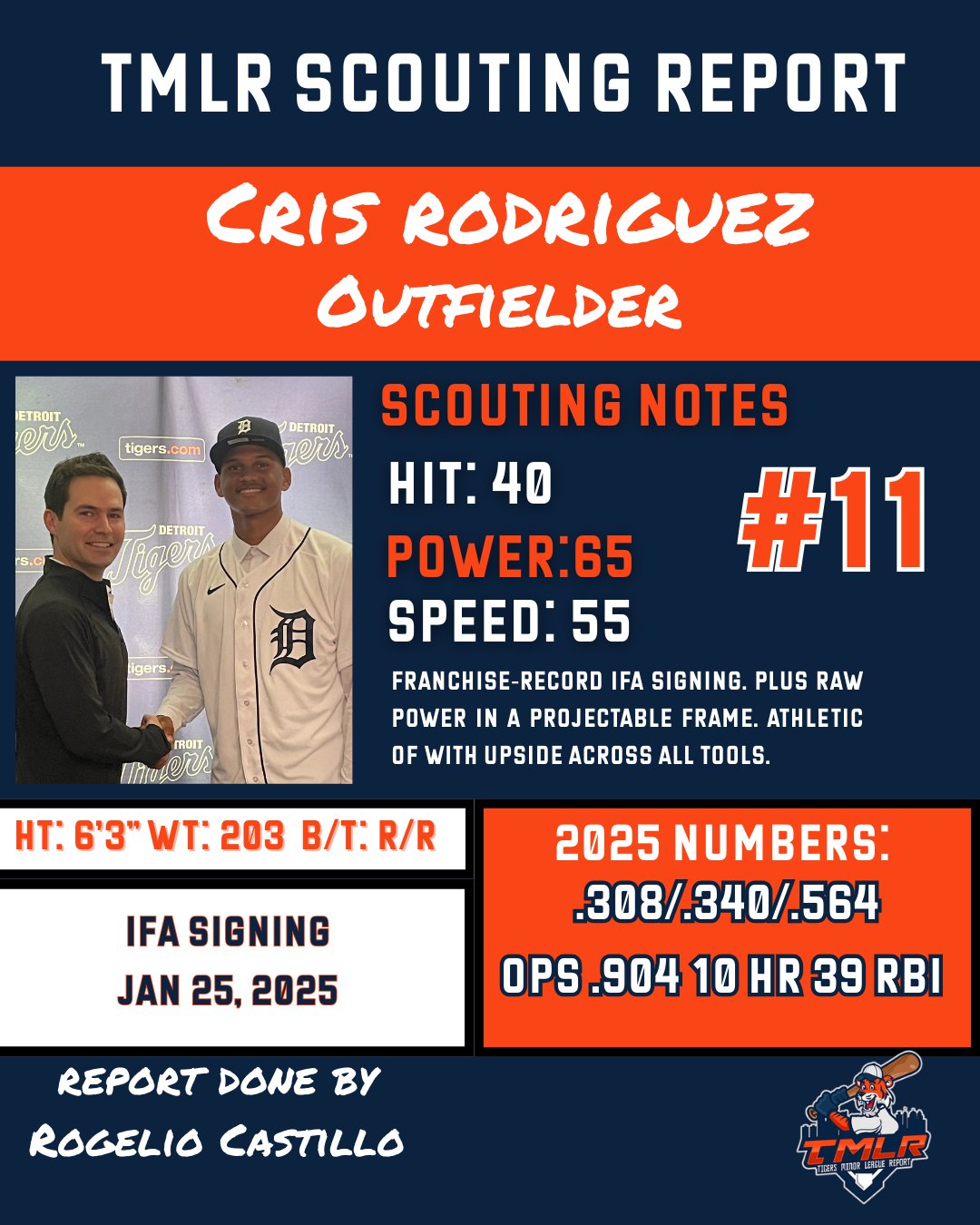
Cris Rodriguez Scouting Report
Background: A native of Santo Domingo, Dominican Republic, Cris Rodriguez entered the 2025 international signing period as arguably the most anticipated position player prospect available — ranked fourth overall by MLB Pipeline and first among power hitters in the class. The Tigers had been building a relationship with him for years and made their intent clear when Scott Harris flew personally to the Dominican Republic for the signing. On Jan. 15, 2025, Detroit locked him up for $3,197,500 — the largest international bonus in franchise history, surpassing the $2.95 million given to Cristian Santana in 2021. He spent his first professional summer in the Dominican Summer League at age 17, where limited video still generated substantial buzz league-wide. A 90th percentile exit velocity of 107 mph and a max exit velocity of 113 mph — numbers that rival active big leaguers — made him the most talked-about teenager in the DSL.
Physical description: Rodriguez is listed at 6-foot-3, 203 pounds, right-handed bat and arm. He’s a physically advanced teenager who already looks the part of a professional hitter despite not yet being old enough to vote. The frame has natural projection for additional strength, and the Tigers believe the power — already elite for his age — will only grow as he fills out. Rob Metzler, Detroit’s VP of scouting, pointed specifically to the bat speed, the bat path and the athleticism as the traits that drove the organization’s commitment.
Hit: 40
The bat-to-ball ability grades average for a DSL teenager, which is actually a meaningful positive given how much raw power he’s already carrying. Big power and hit tool development don’t always coexist at 17, and Rodriguez has shown enough feel for contact to keep the profile from becoming purely swing-and-miss dependent. The chase rate is a legitimate concern — he expanded the zone too frequently against DSL arms and better pitching will punish that more severely. The approach needs to catch up to the physical tools, which is a completely normal developmental challenge for a teenager in his first professional summer.
Power: 65
This is the carrying tool and the reason Detroit wrote a $3.2 million check. A 113 mph max exit velocity at 17 years old is not a DSL anomaly — it’s a legitimate indicator of generational raw power. MLB Pipeline projects double-plus power at maturity, and nothing in his DSL performance walked that back. The in-game power won’t show up consistently until the hit tool matures enough to let him get to his pitch, but when he does, the ball leaves the park. This is the real thing.
Run: 55
Rodriguez is a plus runner right now, which is both a genuine tool and a projection question. He has the natural athleticism to stay in center field if the speed holds as his frame adds muscle, but most evaluators project a corner outfield landing spot — likely right field — as the power develops and the frame fills out. Either way the speed gives him defensive versatility and baserunning value that most power-first prospects his size don’t carry.
Defense: 45
Projecting outfield defense for a 17-year-old Dominican Summer League player is inherently speculative, but the athletic indicators are positive. He moves fluidly for his size, his first-step reads have been solid, and the Tigers have kept him in center field — a meaningful organizational statement. The most likely outcome is a right field profile at full development, and with the arm he carries that is a perfectly viable home for a power-hitting right-hander.
Arm: 60
Baseball America grades the arm at 60, and the physical tools support it. He has the arm strength for right field without any issue and could handle the position at any level. This is a carrying tool in the outfield context and one less developmental variable to worry about.
Overall: Cris Rodriguez is the most significant international investment in Tigers history and the most physically gifted position player prospect in a system that already includes Max Clark and Kevin McGonigle. The comparisons to a right-handed Lazaro Montes — elite slugging potential with a hit tool that needs to catch up — are apt and instructive. The risk is real: the organization’s recent IFA history with Roberto Campos and Cristian Santana is a cautionary tale about projecting big bonuses into big league outcomes. But Rodriguez is a different caliber of prospect than either of those players were at signing, and the exit velocity data from the DSL suggests the power is not projection — it’s already here at 17. The next two years in stateside ball will tell the story on the hit tool. If it gets to even average, this is a future middle-of-the-order bat. If it stalls, the power alone might still be enough to carve out a role. One of the most compelling developmental stories in the minor leagues over the next three years will happen in the Tigers system.
 Ashley Couturier