

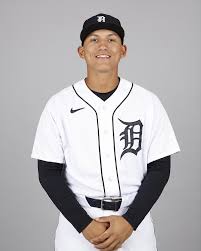
Jesus Pinto Scouting Report
Position: OF
Bats/Throws: Right/Right
Height/Weight: 5-foot-11, 180 pounds
Born: March 30, 2007, Valencia, Venezuela
Signed: 2024 international free agent, Detroit Tigers
Current level: Single-A Lakeland
Jesus Pinto entered the Tigers system as one of Detroit’s more notable international signings from the 2024 class, joining the organization for $897,500 out of Venezuela. That made him Detroit’s second-highest-paid international signing in that class behind Nestor Miranda, and he quickly gave the Tigers a strong first impression in the Dominican Summer League. In 2024, Pinto hit .275/.403/.438 with 12 doubles, a triple, four home runs, 30 walks and 16 stolen bases over 53 games.
That first-year line is still useful context because it shows what makes Pinto interesting. He was not just a raw athlete beating up younger pitching. He showed strike-zone feel, contact ability, some gap impact and enough athleticism to handle center field. His stateside debut in 2025 was interrupted by a hamstring issue, but he still reached Lakeland as an 18-year-old and returned there in 2026 with a more stable full-season sample.
Through his current 2026 line with Lakeland, Pinto is hitting .233/.337/.337 with eight doubles, two triples, two home runs, 25 walks, 44 strikeouts and nine stolen bases in 199 plate appearances. The slash line does not jump off the page, but the plate-discipline indicators are the part worth watching. His 12.6% walk rate and 22.1% strikeout rate are both solid for a 19-year-old in the Florida State League, especially one who is still learning what kind of hitter he is going to be.
The broad read is this: Pinto has a better baseball foundation than the surface slugging suggests. He controls the zone, can make contact in the strike zone, has enough bat speed to project more than empty singles, and owns one of the better outfield arms in the lower part of the system. The question is whether he can turn that contact into more damage.
Hit: 50
This is the strongest part of Pinto’s offensive profile right now. He is not overpowering the level, but he is showing a mature approach for his age. In April, Pinto hit .257/.382/.378 with 15 walks and 18 strikeouts in 89 plate appearances, which put the early-season spotlight on his ability to control the zone. Chris Brown has noted as one of the system’s early risers because of that walk-to-strikeout profile, and the underlying data backed it up.
The swing itself is more controlled than explosive. Baseball Savant’s scouting notes describe Pinto as a right-handed hitter who uses a toe tap, keeps his lower half under control and stays short to the ball. That tracks with the numbers. He has not had a major swing-and-miss issue, and he has been noted among Florida State League leaders in in-zone contact early in 2026.
The risk is that a contact-first approach can become passive if he does not start impacting the ball more consistently. Pinto has the hand speed to put balls in play, but the next step is finding better contact quality without giving back too much of the approach.
Power: 40
Pinto’s power is the tool with the widest range of outcomes. There is more raw strength than the current home run total shows, but his batted-ball shape has not fully unlocked it yet. Through 199 plate appearances in 2026, he has 12 extra-base hits, eight doubles, two triples and two home runs, with a .104 isolated power. For his full minor league career, he has 37 extra-base hits and a .126 ISO across 538 plate appearances.
That is not a corner-outfield power profile yet. The reason to leave some projection here is his age, frame and contact quality. Baseball Savant notes that his raw exit velocities have been solid, but his angles have been subpar, with a ground-ball-heavy profile at Single-A.
Run: 50
Pinto is more of an average runner than a true burner. He stole 16 bases in the DSL in 2024, but his stolen-base efficiency has been mixed since then. In 2026, he has nine steals and five caught stealings, and for his career he is 34-for-52. That is enough speed to be useful, but not enough efficiency to project him as a major base-stealing threat unless the reads improve.
The speed plays better defensively than it does on the bases. Pinto has spent most of his career in center field, and he has enough instincts to cover ground there in the low minors. Long term, the run tool is probably closer to functional average than impact.
Defense: 50
Pinto has played primarily center field, with some right field and left field mixed in. In 2026, he has logged 27 games in center, 13 in right and five in left for Lakeland. For his career, he has more than 780 innings in center field, which shows the Tigers have given him every chance to remain there.
The glove is solid, but the future position is not locked in.
Arm: 60
This is Pinto’s loudest defensive tool. A plus arm gives him more defensive value and allows the Tigers to move him around all three outfield spots without losing the throwing component. If the bat becomes more impactful, the arm makes right field a realistic long-term fit.
Overall
Pinto is not the flashiest player in Lakeland, but he may be one of the more important developmental follows in the lower minors. The profile is built around age-relative approach, contact ability, center-field experience and a plus throwing arm. The offensive separator will be whether he can turn controlled contact into more lift and damage.
The current version looks like a potential fourth outfielder with on-base skills, enough center-field ability and a strong arm. The better version is a regular-adjacent right fielder or center-field-capable outfielder if the power climbs into the 12-to-18 home run range. The risk is that the bat stays too ground-ball heavy and the profile gets squeezed if he moves off center.
For now, the report is simple enough: Pinto controls the zone better than most 19-year-olds, makes enough contact to project a usable hit tool, and has an arm that belongs in right field. The next jump comes from slugging, not chasing more, just driving the baseball with better angles.
 Ashley Couturier